Siskiyou wildflowers and butterflies

Our roadside botanizing was especially exciting today. First perhaps I should explain why we walk along forest service roads instead of hiking along trails. It has a lot to do with a single plant, although not one I would describe as a widlflower.
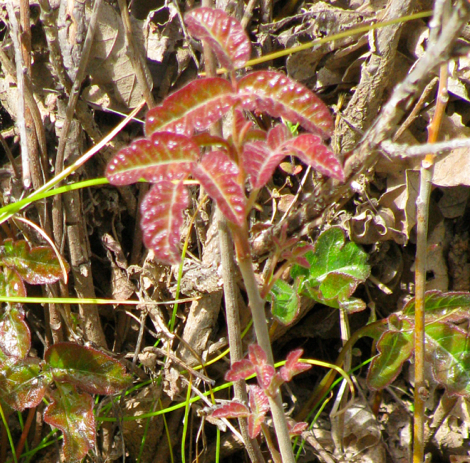
PoisonOak.jpg

Yes, it’s poison oak (Toxicodendron diversilobum), seen above early in the spring before it has reached its full diabolical potential of thickets six feet tall, stretching branches out onto trails in search of sunshine in order to grow even more monstrously large. Poison oak could be an interesting plant: it occurs in various forms from semi-vines threading up tree trunks, to a low-growing ankle-ambusher, as well as the aforementioned woody thickets. But all parts contain a chemical that is—not poisonous—but an extremely powerful allergen, an oil called urushiol. Most people are allergic to it, and I am very very allergic, so once we get off of bare ground I spend most of my time looking down and around before every step in order to find it before it finds me. (Be warned: allergies can come and go, so a history of immunity doesn’t mean you’ll always be immune.)

Happily, there’s an abundance of things to see by walking along the road and making a few careful excursions. Today was a bonanza.

LewWelch3.gif

There’s an audio recording of Lew Welch reading this, here.

I don’t think we saw anything that “nobody’s ever really seen”, although one must pay careful attention to Lew Welch’s language, that “really seen” part. But what we saw was marvelous. Here’s one sight:
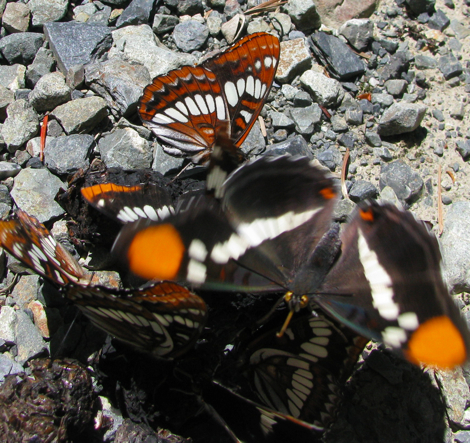
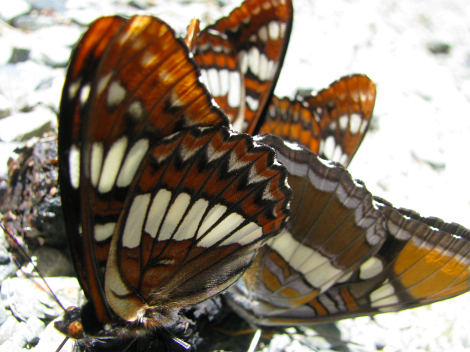
ButterfliesOnScat2.jpg

ButterfliesOnScat1.jpg

From a distance I thought the butterflies were gathered upon a damp patch improbably located in the middle of the hot dusty gravel road. In other such situations, I haven’t been able to approach very closely without scaring them off. I took some pictures, then moved a bit closer, closer still, and in the end I was kneeling right beside them without really disturbing them at all. And then I could see what it was that they were so attracted to.

ButterfliesOnScat3.jpg

They were on the scat of some animal, not an uncommon territorial marker to find in the middle of these forest roads. Could be fox, raccoon, coyote. Undigested material including seeds and some woody bits (pine needles?) can be seen, and the scat is pretty dry. Unlikely to be a source of moisture. However, butterflies require minerals not found in nectar, and often get these by drinking from damp soil or applying their tongues to scat. I am curious how they get nutrients from dry materials, because their tongues are hollow tubes designed for drinking liquids.

I poured some water on a nearby area before we left in search of lilies. When we came back, all the butterflies were still on the scat.

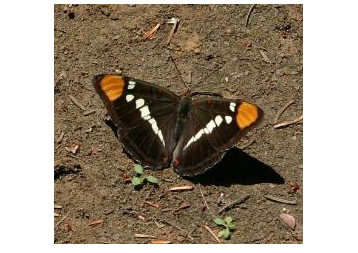
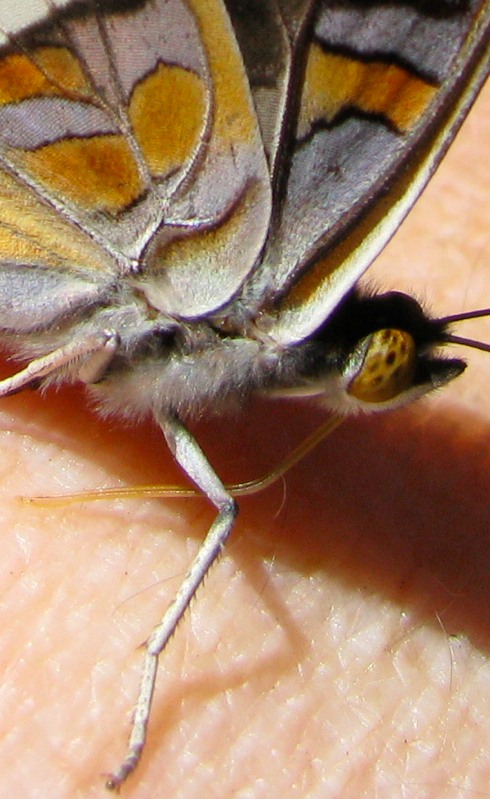
There were two species there. One was Adelpha bredowii, California sister, shown here exploring my arm. Some photos (here, for example) show this species with blue rather than grey markings, but that may be local variation.

Adelpha bredowii, California sister.jpg

What’s the “sister” about? It’s said to refer to the black and white markings (like a nun’s habit) on the other side of the wings, the dorsal side (looking down on the outspread wings and the insect’s back, from above).
Adelpha bredowii, dorsal view.jpg

Photo source.

The other is Limenitis lorquinii, Lorquin’s admiral. There are several different butterfly species with “admiral” in their names, and the reference is not clear. Some say the names were originally “admirable” but I can find no support, just speculation. Lorquin was a Frenchman in California during the Gold Rush of 1850, who sent butterfly specimens back to France where they were described for the first time by eminent lepidopterist Jean Baptiste Alphonse Dechauffour de Boisduval.

Limenitis lorquinii, Lorquin's admiral.jpg

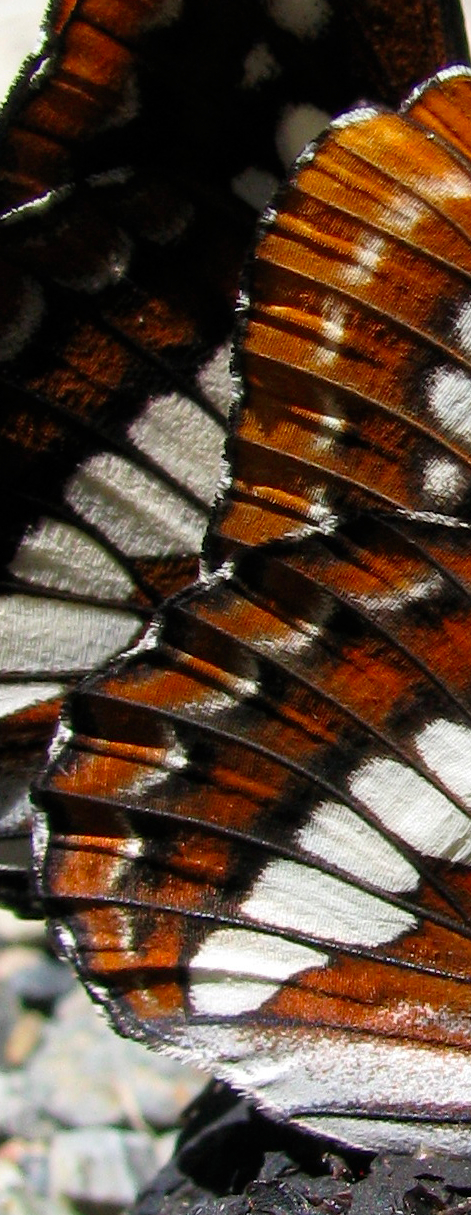
It is unbelievable to see these creatures in such detail. First, Limenitis lorquini.
Limenitis lorquini close-up.jpg

It is possible to see the wing-veins as the three-dimensional structures that they are. When we read that a new butterfly emerging from the chrysalis has to “pump up” its folded wrinkled wings, before they are strong enough to fly, these veins are the means. “The butterfly has to expand and dry [its wings] as soon as it emerges from the chrysalis. To do this, it uses its body as a pump and forces fluid through a series of tube-like veins. It’s a little like inflating a balloon — as the veins fill with fluid, they slowly stretch the surface of the wings.” Source.
Adelpha bredowii, closeup.jpg

Adelpha bredowii, trailing its long tongue over my skin.

We went on to look at the Washington lilies described in my previous post. The blooms that were white and pink on June 24th,

Washington lily 3.jpg

today were nearly bright pink and drooping.

WashingtonLiliesOld.jpg

But another plant was in spectacular bloom.

Philadelphus lewisii-1.jpg

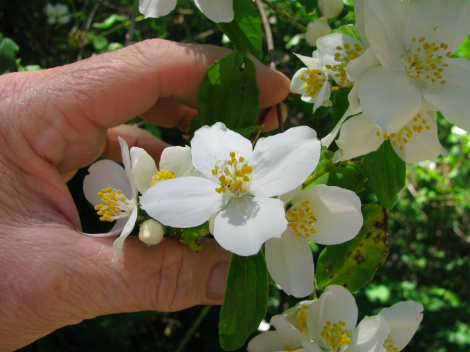
This is Philadelphus lewisii, commonly called mock orange for its fragrance. To me there was nothing citrus-y about the fragrance, but I’ve never smelled orange trees in bloom. (There are perhaps a dozen other plants also called mock orange, illustrating how treacherous common names can be.) Philadelphus lewisii is one of nearly 200 plants new to science which Lewis and Clark described. Indians used its straight stems in making arrows.
Philadelphus lewisii-2.jpg

On the drive back to the main road we saw many more, all in synchrony of bloom. It’s a shrub that can reach 12 feet, so it offers a lot of flowers! We had remarked earlier on how many butterflies were about, in the air: monarchs, tiger swallowtails, and others. Surely the Philadelphus extravaganza had something to do with the sudden abundance of butterflies, and we speculated on how insects and plants keep in step when the music of the dance—the temperature, rainfall, sunny or cloudy skies—can vary so drastically year to year. This long rainy spring was very atypical, yet after three sunny days here are the partners right in step.

Another unusual find will have to wait for my next post. It has something to do with this wild rose…

WildRose1.jpg

Siskiyou wildflowers: Washington Lily

Washington lilies buds.jpg

For two months we have been watching these lily plants, waiting for them to bloom. It took several days of sun and 80 degrees or so to coax them into revealing their flowers.

Washington Lily 5Dan.jpg

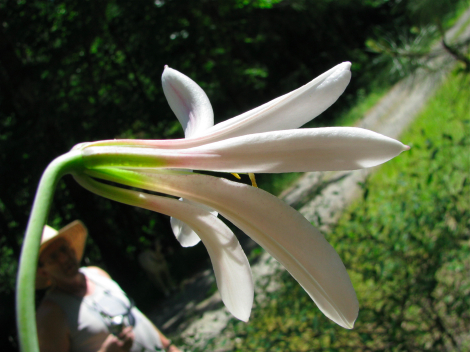
These are Washington lilies, Lilium washingtonium. The flowers are white, sometimes pinkish, with tiny pink or purple dots inside.

Washington lily 3.jpg

Despite the name, these are not found in Washington state, but only in Oregon and California. The plant was first described in 1859 by Albert Kellogg, who went against the usual practice of botanists and used the local settlers’ name, Lady Washington Lily, as basis for the scientific name. Presumably the settlers were referring to Martha Washington.

Turner calls them “uncommon”, and these are the only ones we have seen in our area. There are four plants within a six foot radius. One has had its top foot or so nipped off by some browsing animal, and one has not formed buds—too young perhaps.

Washington lily 2.jpg

Uncommonly beautiful they certainly are. And they bear a sweet fragrance.

Washington lily 4.jpg

Wild strawberries

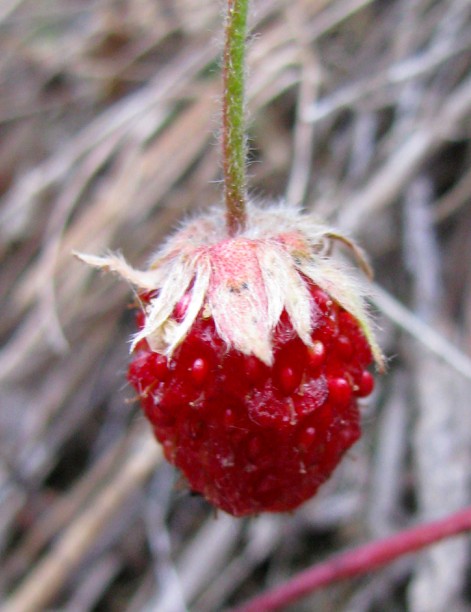
It’s been a cool wet spring here in the Siskiyous, but on June 9 we found wild strawberries with dead-ripe fruit.

WildStrawberryRipe.jpg

Irresistible! The fruits were tiny, maybe half an inch in diameter, and didn’t want to separate from the leaves so we each ate one leaves and all. Very juicy and red, sweet, but the intense strawberry flavor I expected to find wasn’t really there. Maybe it’s been enhanced by horticultural selection? Or I got one that wasn’t too tasty? I don’t think a store-sized berry could be so ripe as these were, without being a shapeless blob.

WildStrawberries GreenLeaf.jpg

As to species, this plant could be either the woodland strawberry (Fragia vesca) or the Virginia strawberry (F. virginiana). Both are found all across North America, and are hard to tell apart. In common parlance, the name “wild strawberry” is applied rather indiscriminately to these two species. A third bearing strawberry in North America is F. chiloensis, the beach strawberry, Chilean strawberry, or coastal strawberry, native to the Pacific Ocean coasts of North and South America, and also Hawaiʻi. Migratory birds are thought to have dispersed F. chiloensis from the Pacific coast of North America to the mountains of Hawaiʻi, Chile, and Argentina.

A hybrid of F. chiloensis (for size) and F. virginiana (for flavor) was first made in 1840 in France and this lineage replaced F. frascaand Musky strawberries (F. moschata) as the commonly cultivated strawberry. But people harvested them long before they cultivated them, and one source says that it was “probably during this time that they acquired the name strawberries from the practice of threading them on straws whilst harvesting them,

Strawberries on a straw.jpg

Photo source.

or possibly from the term ‘streabariye’ used by the Benedictine monk Aelfric in AD995 to describe the st[r]aying habit of the runners. Certainly the name strawberry was used long before the practice of placing straw around the fruiting plants became widespread.”

WildStrawberriesRedLeaf.jpg

A web furnished for concealment, Cyclosa conica

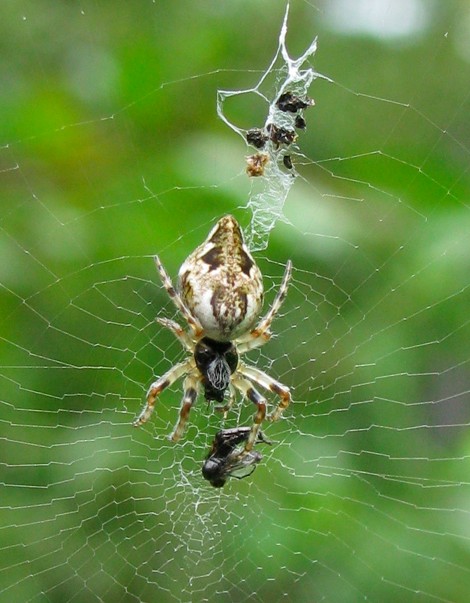
Yesterday’s forest walk, along an alarmingly narrow dirt road next to a hundred-foot drop, introduced us to Cyclosa conica

Cyclosa conica 0781.jpg

a spider with an unusual tactic for concealment. On its web it makes a vertical strip of reinforced filaments, called a stabilimentum, to which it adds the husks of its prey. Females often place their egg sacs in the stabilimentum too. Then the spider hides itself at the center of this little visual interference area it has made, while it waits for insects to fly into the web.

The vertical strip of insect remains is clear in the photo above, and here’s a closer look at the arachnid itself.

cyclosa conica CR 0781.jpg

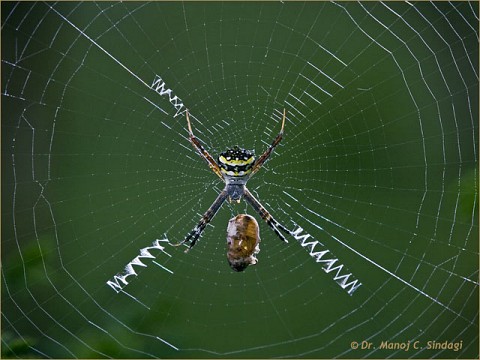
The stabilimentum is used in various forms by other orb-weaver spiders (family Araneidae, the builders of spiral wheel-shaped webs).

zig-zag2.jpg

Above, the “Writing or Signature Spider”, Argiope sp., photo taken in Singapore. Source.

Zig-zag3.jpg

Above, stabilimenta of Argiope sp. take different shapes including circular and cross-shaped. Photo from Wikipedia.

What are the functions of the stabilimentum?

Various theories have been propounded as to the effect of the stabilimentum: strengthening the web, preserving the web by causing birds to avoid it, even attracting insects (although it would be natural to think that the more solid-looking stabilimentum might make the webs easier for insects to avoid). The spider we saw makes it into a “decorated” hiding place, but that is most likely an embellishment by this one species upon a structure originally serving other purposes.

In 1998 I-Min Tso, now a professor at Tunghai University in Taiwan, did a field study with Cyclosa conica (the spider we photographed) to find out whether “Stabilimentum-Decorated Webs Spun by Cyclosa Conica (Araneae, Araneidae) Trapped more Insects than Undecorated Webs”. He was able to make the comparison because where he worked (near Pellston, MI), the spiders sometimes omitted the stabilimentum (and 18 out of 24 webs with stabilimenta had no prey included in the “decoration”). This seems odd, as the stabilimentum with prey is cited as a characteristic of the genus Cyclosa, but maybe other observers have failed to notice instances of C. conica webs that lack the stabilimenta, or lack the wrapped prey within them. At any rate, Dr. Tso found that webs with stabilimenta caught more prey than plain webs even when the plain ones were larger. Similar results have been found for other species that add stabilimenta to their webs.

How might this work? At least one species, Argiope argentata (one of the Argiope spp. known as the “Writing Spider”), is said to spin special UV-reflecting silk for the stabilimentum. Theoretically this makes it more visible to insects, like the UV patterns on flowers, which tend to be “bull’s-eyes” surrounding the center where pollination takes place. In a laboratory where the light could be manipulated to contain UV radiation or not, fewer fruit flies flew to webs when the UV light was not present (webs were those of juvenile Argiope versicolor).

UVFlowers.jpg

Seen in UV, these flowers have a wide black “target”. Photo by Tom Blegalski/TTBphoto, from geneticarchaeology.com.

Under that theory, insects would fly toward the attractive UV center of the web (the stabilimentum) and not see the less-visible “this is a spider web!” part until too late. The theory fits the Writing spider, which prefers open sunny areas, better than our C. conica, which lives in sun-and-shade forests.

But the theory may be too good to be true, given that we don’t actually know enough about insect vision and behavior, and there is even disagreement regarding how UV-reflective spider silk is. In the real world, light conditions vary from place to place and moment to moment, even as a breeze changes the orientation of a web slightly, making it difficult to assign easy labels like more visible/less visible. And the visual systems of insects vary, with many being (I venture to say) unknown. The Australian spider Argiope aetherea was found to adjust “the quantity of silk decoration… adding more silk decoration when the web was located in dim light rather than bright light.” The authors of this study cite their findings as evidence that is “[c}onsistent with the prey-attracting function”, but of course it would also be consistent with any other function that involved visual perception even without UV involvement, e.g. signaling birds to avoid the web.

As a non-scientist, I’ve probably taken this topic far enough; the visibility and function of web decorations have been argued over for a hundred years, and modern technology seems merely to guarantee that each investigator with a spectrophotometer reaches a different conclusion from the others. One article (1), in 2005, summarizes areas of difference and ambiguity, ending with a possible redirection of emphasis: “The contrast of web decorations is consistent between families and different decoration patterns, raising the exciting possibility that their shape rather than spectral properties might explain variation in receiver response.” But there’s a review of the evidence in a long article not available online (2, abstract only), and now that my curiosity is up, I’m seeking a reprint of it.

1. Bruce, Matthew J, and Astrid M Heiling and Marie E Herberstein. 2005. Spider signals: are web decorations visible to birds and bees? Biology Letters 22 September 2005. 1 (3): 299-302.

2. Herberstein, M. E. , C. L. Craig, J. A. Coddington and M. A. Elgar. 2000. The functional significance of silk decorations of orb-web spiders: a critical review of the empirical evidence. Biological Reviews of the Cambridge Philosophical Society. 75 : 649-669. [abstract]

More photos and information about Cyclosa conica

eurospiders – good photos including extreme closeups of body parts

Range map

Cyclosa is derived from the Greek “kyclos” meaning “round” possibly with reference to its orb-web. Conica refers to the conical shape of the abdomen.

Cyclosa conica web 0781.jpg