Small Oregon Port hosts giant cruise ships

Astoria, Oregon, is a port town of about 10,000 at the mouth of the mighty Columbia River. It’s rich in history, and calls itself “the oldest American settlement west of the Rockies”. Lewis and Clark wintered near here at a fort they built after reaching the Pacific in 1805; the town itself began as a fur-trading site for John Jacob Astor; it is the site of the Astoria Column, a 125-foot (38 m)-tall column with an observation deck at the top and a spiral frieze all the way up depicting events of Oregon history; fancy Victorian homes dot its hills, remnants of the fortunes that were made in lumber, shipping, and salmon fishing. But it’s a small port these days. Many big cargo ships bypass Astoria, going up the Columbia to off-load at Portland, and timber exports have declined. For years Astoria has been wooing cruise ship traffic, putting $10M into piers to accommodate the larger cruise ships. The Port has organized volunteer “cruise hosts” to lead tours and make visitors feel at home.

This year the preparations really paid off, as ships cancelling their planned stops at Mexican ports due to the H1N1 flu are looking for alternatives, and Astoria was ready. The scheduled 13 ships stopping in Astoria expanded to 21 for the season, and one of the biggest pulled in on May 12 for a few hours. Royal Caribbean’s Mariner of the Seas is 1,020 feet long and carries 2,700 passengers. The Port’s marketing director said that about 80% of cruise passengers generally disembark when the ships stop.

There were tours for all sorts of interests: history and bicycling at Fort Clatsop (the Lewis and Clark overwintering site which has been re-created in replica, with historic re-enactors); galleries, shops, and restaurants; the Columbia River Maritime Museum; Seaside and Cannon Beaches; “Shot in Astoria”, a tour of locations where movies have been recently filmed; a refurbished 1920’s vaudeville and movie theatre; the great view from the Astoria Column, high on its 600-foot hill, and more. And just walking around taking in the river, the ocean, the hills and the city, is worth a visit.

AstoriaColumnTop3.jpg

Top of the Astoria Column, photo by Terry Richard/The Oregonian.

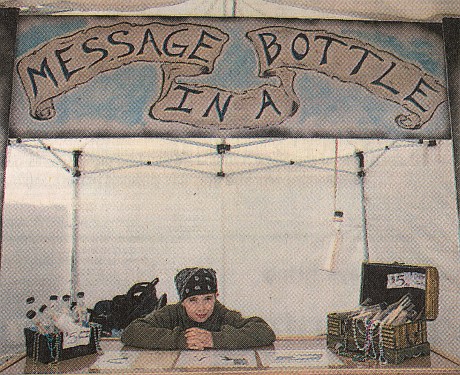
And perhaps best of all was eleven-year old Tyler Delay selling messages in a bottle! Are they bottles for the visitors to toss in the ocean, having added their own notes inside, or mysterious ones that Tyler has scoured up himself in years of beachcombing? Guess we’ll have to go to Astoria to find out.
AstoriaMessageinABottle.jpg

Photo by Ross William Hamilton for The Oregonian, accompanying The Oregonian’s article (from which most of this information is derived). Sorry this photo isn’t as good as it should be; it wasn’t part of the online article and was scanned from the newspaper.

Wander through the history of world art

The Heilbrunn Timeline of World Art, on the Metropolitan Museum of Art site, is a garden of delights in which one can easily become lost. It now includes over 6000 items and more are being added. Covering the time period from 20,000 BCE to the present, the site allows exploration by keyword or subject, name of artist, time period, country or region, time period and region, medium, and more. You can even sort the alphabetical list of essays by region or time period, see a cultural time line (e.g. Central and North Asia, 8000–2000 B.C.), or search for something specific in both the Timeline and the Met’s overall collection database. I searched for “hat,” and found 2020 hits in The Costume Institute, and 75 in the Heilbrunn Timeline itself.

I arrived at this site while googling prehistoric Japanese sculpture (of the “Jomon” culture) and then somehow found myself looking at Moroccan embroidery and a 19th c. American quilt using squares with the signatures of notables of the time such as Ralph Waldo Emerson.

Each item has at least one photo that can be viewed in two sizes, a short description, and perhaps most enticing, links to other pieces related by time period, region, or material. Short essays are provided for many topics. Here’s one on the American Arts and Crafts movement; here’s one on a site in China, dated to 7000 BCE, with pictograms and bone flutes–”the earliest playable musical instruments” found (disputable, but let’s not carp).

Go to the list of artists and sort them according to medium or type of work: performance artist, calligrapher, painter, weapons maker, architect, metal worker, etc.

If this sounds wide rather than deep, who can complain? African Rock Art, Albrecht Dürer, Arms and Armor—Common Misconceptions and Frequently Asked Questions, Ancient Greek Dress, Botanical Imagery in European Painting, the Bikini, the Bronze Age, the Bauhaus…if I had to choose a few sites to be able to access on a desert island, this might make the list. (All of the foregoing are thematic essays on the A-B page.)

Embroidered panelMorocco.jpg

Above, embroidered panel, ca. 1800, Morocco.
Linen, silk; 9 ft. x 32 1/2 in. (274.3 x 82.5 cm)

Purchase, Everfast Fabrics Inc. Gift, 1970 (1970.272)
One of the rarest and finest examples of Moroccan embroidery, this wall hanging (arid) displays the most remarkable achievement of a Chechaouene needlewoman’s skills. The arids were used to cover the surrounding areas of interior arches in matching sets. Worked in plaited stitch, these panels contain geometric motifs based on tracery, arabesques, stars, rectangles, and diamonds, all closely associated with Andalusian elements. Said to have been used as an altar curtain in a Nestorian church in Jerusalem, this particular piece is certainly conversant with a variety of cultures and civilizations. The importance of embroidery in Moroccan life can be illustrated by the ceremony held for every infant girl at the age of four months, when the baby was placed in a chair and given a needle and thimble along with some silk thread to hold, in anticipation of a life blessed with the needle’s art.

[The images may be used for non-commercial purposes, with credit to the source, but the museum stipulates that the accompanying text must be used also.]

AutographQuilt2.jpg

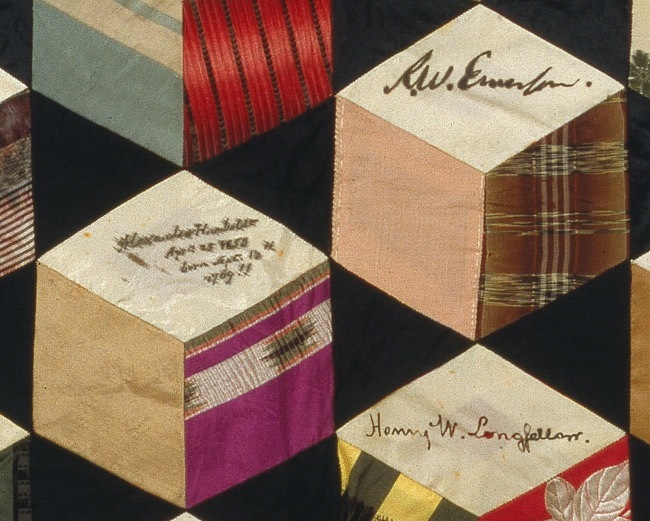
Above, detail, Autograph quilt, ca. 1856–63, by Adeline Harris Sears (American, 1839–1931). Silk with inked signatures; 77 x 80 in. (195.6 x 203.2 cm).
Below, entire quilt.

Purchase, William Cullen Bryant Fellows Gifts, 1996 (1996.4)
In 1856, seventeen-year-old Adeline Harris, the daughter of a well-to-do Rhode Island mill owner, conceived of a unique quiltmaking project. She sent small diamond-shaped pieces of white silk worldwide to people she esteemed as the most important figures of her day, asking each to sign the silk and return it to her. By the time the signatures were all returned and ready to be stitched into a “tumbling-blocks” patterned quilt, Adeline had amassed an astonishing collection of autographs. Her quilt features the signatures of eight American presidents; luminaries from the worlds of science, religion, and education; heroes of the Civil War; such authors as Charles Dickens and Ralph Waldo Emerson; and an array of prominent artists. Today, the autographs displayed in this beautiful and immaculately constructed quilt provide an intriguing glimpse into the way an educated young woman of the mid-nineteenth century viewed her world.

AutographQuilt1.jpg

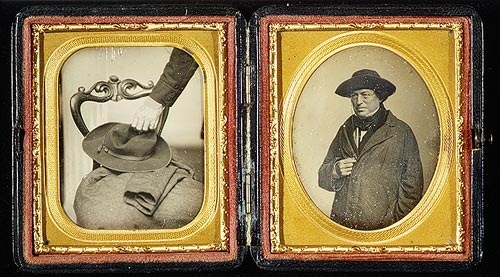
Below, one result of the “hat” search: [Cornelius Conway Felton with His Hat and Coat], early 1850s
John Adams Whipple (American, 1822–1891)
Daguerreotype; Each 3 1/4 x 2 3/4 in. (8.3 x 7 cm)

The Rubel Collection, Purchase, Lila Acheson Wallace, W. Bruce and Delaney H. Lundberg, and Ann Tenenbaum and Thomas H. Lee Gifts, 1997 (1997.382.41)
This rare daguerreotype diptych shows Cornelius Conway Felton (1807–1862), Eliot Professor of Greek Literature at Harvard University, reaching for his felt hat and duster. The first son of a poverty-stricken furniture maker, Felton became one of the most renowned classical scholars in the country and, in 1860, Harvard’s president. Although Felton donned academic robes, he never lost his connection to the everyday experiences of common folk. As opposed to the inflexible silk top hat worn by dandies and professors alike, the broad-brimmed felt duster that co-stars here was worn by outdoorsmen and was practical, casual, and fundamentally democratic.

Hat1.jpg