Total knee replacement surgery, the second time around: learn from our experience

Nearly three years ago my husband had Total Knee Replacement (TKR) surgery. It’s drastic and major surgery, which people usually only choose when the pain from osteoarthritis becomes intolerable. And, it was not done properly so that last month it had to be re-done! Perhaps our experience can be useful to others.

Why do knees need to be replaced?

Generally because of pain and restricted motion caused by loss of cartilage (which cushions and separates the bony parts of a joint) and growth of bony “spurs”. This is labelled osteoarthritis. Other causes, like trauma, rheumatoid arthritis, and infection, account for a minority of the 300,000+ TKRs each year in the US.

As to what causes osteoarthritis, that is less understood than previously thought, when it was all blamed on “wear and tear”. The knee is the largest joint in the body, and bears the complete weight of the body at each step we take, so it is indeed subject to lots of “wear and tear”. Common-sense risk factors include types of high-stress activity in work or sports, injury, obesity, infection, stiffness from lack of activity, and age (since cartilage becomes more brittle with age). However, not all elderly people develop arthritis and some who do have no significant pain. This is why I said above that knees need to be replaced, not because of osteoarthritis, but because of pain and reduced range of motion.

The biologic factors leading to the deterioration of cartilage in osteoarthritis are not entirely understood. Many experts believe that osteoarthritis results from a genetic susceptibility that causes some biologic response to injuries to the joint, which in turn leads to progressive deterioration of cartilage. In addition, the ability to make repairs becomes progressively limited as cartilage cells age.

Although osteoarthritis generally accompanies aging, osteoarthritic cartilage is chemically different from normal aged cartilage. As chondrocytes (the cells that make up cartilage) age, they lose their ability to make repairs and produce more cartilage. This process may play an important role in the development and progression of osteoarthritis. [Emphasis mine. Source: www.healthcentral.com ]

What’s involved in Total Knee Replacement surgery?

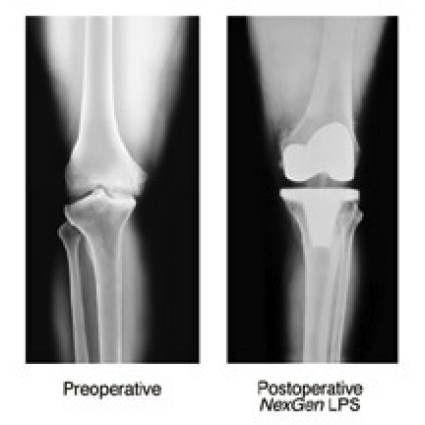
The x-rays below, from the site of a prosthetics manufacturer,
kneeXraysB&F.jpg

show views of a knee before and after surgery. On the left, cartilage loss has caused bone-on-bone contact: very painful. Bone spurs or bits of broken bone floating around can also cause pain in the deteriorated joint. On the right, an artificial knee joint (prosthesis) is in place. (These are not x-rays of the same knee; in fact, looks to me like one’s a left leg and the other is a right leg.)

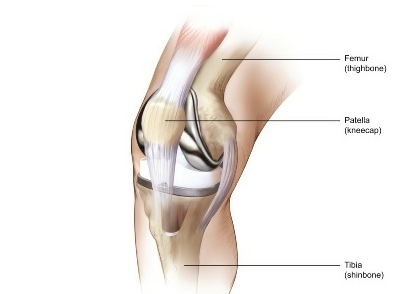
Here are some views of prostheses. To install them, the ends of the two long-bones of the leg, tibia and femur, are sawed off (removing “usually between 2 and 12 mm” according to one source) and the artificial joint is affixed with cement, screws, etc. The work involved in removing bone and attaching the prosthesis involves considerable force and power tools. Note that the knee-cap, as well as muscles and ligaments, must be carefully moved aside to install the prosthesis. [Picture sources: 1, 2, 3 ]

KneeProsthesis1.jpg

knee-bone&prosthesis.jpg

knee-implant1.jpg

There are many patented designs for artificial knee joints, and these illustrations are for general example only. Surgeons have their preferred models; many were developed by orthopedic surgeons, and those surgeons tend to prefer the ones they have an interest in. Choice of prosthesis isn’t something the patient can weigh in on, we don’t know enough, but you may want to find out if your surgeon has a financial interest in the one he is going to use; if so, perhaps a second opinion would be valuable on the pros and cons of various types as applied to your individual case. Most insurance will pay for a second opinion for major surgery.

Research continues for better, longer-lasting designs and breakthroughs are regularly announced with fanfare––but some don’t fulfill their original promise, as with teflon-lined joints which wore away much faster in practice than lab tests had predicted. You will have to rely on the experience of your surgeon.

You can see photos of the stages of knee surgery (not for the faint-hearted) here, on a prosthesis company ‘s site.

Our experience

Surgery #1, 2006

Now, back to my husband’s case. Dan had knee pain for years that ruled out unnecessary walking, as in hiking or walking for enjoyment, and interfered with sleep. There was bone on bone contact and perhaps bone spurs or growths from osteoarthritis. In August 2006 he underwent total knee replacement surgery by an established older orthopedist in our area. Afterwards, the surgeon came out to me in the waiting room and told me that the operation had taken half again as long as planned because they had “run into something unexpected”. Later, when we knew more, that remark would have much more significance to us. The “something unexpected” was apparently the result of a broken leg at age ten, that had caused greater reliance on the other leg (the one that received the TKR).

The surgery was brutal, with terrible bruising all over the leg, and post-op pain and swelling were severe. From the beginning, the prosthesis felt loose and insecure, sometimes the knee buckled, and after the post-surgical pain subsided, he was still in pain sufficient to make walking difficult. At each visit with the surgeon Dan raised these issues and was told to exercise more, and that it would get better with time. Two years on, that hadn’t happened, and the surgeon then agreed that the knee was a bit loose and offered to go back in and “put a shim in it”.

At some point after the 2006 operation, when it became apparent that it had been unsuccessful, I began to research the subject. Immediately I found that it’s common practice now to use Magnetic Resonance Imaging before TKR, rather than merely relying on x-rays. MRIs provide an exact and minutely detailed three-dimensional picture of the joint. The data can be used to make a 3-D visualization that can be rotated. This way the surgeon knows exactly what to expect; the prosthesis is customized, if necessary, beforehand; the surgery is generally shorter and the incision may even be smaller. (Other advances, such as computer-assisted orientation systems to guide the surgeon in positioning the prosthesis during surgery, may also be used.) Nothing like this was done in Dan’s case, and we didn’t know to ask about it. We know now that the original surgeon does have access to an MRI, in the hospital across the street from his office, and used it to look at Dan’s hip after the bad artificial knee began to cause a lot of pain in his hip, back, and other knee. But he didn’t use it for the knee needing replacement.

Surgery #2, 2009

Finally, after the remark about putting in a “shim”, we began to look for another surgeon. I searched online for someone who used MRIs and computerized techniques for joint replacement and who was experienced in what I learned is called “revision” (re-do) of TKRs. (Some surgeons, including the only other ones in our area, won’t touch someone else’s failures.) I found a surgeon who met these qualifications, about 4 hours drive from where we live, and we went to see him. The first thing he did was to get a full-leg digital x-ray, which surgeon #1 had never done. He showed us the x-ray, and used software to examine the precise alignment of the prosthesis. It was 7.5° out of alignment. In effect, his lower leg-bone had been detached and then put back on at a different angle from the upper leg. For over two years the first surgeon had taken no steps to examine the results of his surgery, other than feeling the knee.

We liked what we saw here, added to what we already knew about Surgeon #2’s experience, and proceeded with the preparations for a revision.

In late May Dan went through the revision surgery. Pry off the old, shave off a little more bone, affix the new.

When the surgeon met with me afterward in the waiting room, he had troubling things to report but they weren’t about what had just taken place. He told me that the prosthesis he had removed was badly installed. He actually used the word “sloppy”––and you know how rare it is for doctors to criticize one another’s work! The lower part was out of alignment both front-to-back and side-to-side; the upper part was supposed to be stabilized by the bone growing into it on all sides, but this had not taken place (he remarked that he did not use this model because sufficient bone regrowth often failed to occur). So this artificial joint had been loose and seriously mis-aligned, with every step stressing both parts of the prosthesis, the ends of the bones, the muscles/ligaments/tendons, and the other joints involved in walking (back, hip, other knee). It was clear, said the surgeon, that this had been causing Dan considerable pain, and he felt confident that the new prosthesis was going to be a great improvement.

Today is post-op day 19, and there is no comparison between the two post-op experiences. The day after the surgery they got Dan on his feet, and the first time he put his weight on the new knee he said that it felt more solid than the old one ever had. The next day he was walking the hall, slowly, and walking without hip pain for the first time in ten years. Bruising of the leg is minimal, the incision is shorter, and pain is less. The first time he was using fentanyl patches, very heavy opioid painkiller, and was still in too much pain. This time it is Tylenol-3 every 4 hours, and ultram (tramodol) occasionally when needed.

The incision is closed with superglue, covered with crossways lengths of what looks like strapping tape: no staples to distort the skin and then have to be removed. He was able to take a short shower on post-op day 5. Last time the first shower was not permitted nearly so soon and he was in so much pain he had to sit down on a plastic bench in the shower. This time, he was easily able to stand and feel secure. He’s in pain, but not nearly as much as last time, and the solidity of the knee makes it possible for him to get around the house carefully but confidently, only occasionally using his walking stick for stability (and to keep the dogs from bumping him).

Like the first time, the anesthesia was a spinal block (not general anesthesia) but the new surgeon added a femoral nerve block. As I understand it, the spinal keeps pain messages from reaching the brain during surgery; the femoral block keeps the nerves immediately affected by the surgery from registering pain which gets the nerves excited even though the brain doesn’t hear about it. It’s supposed to lessen post-op pain and it certainly seems to do that, especially for the first 24-36 hours.

There is swelling, but it’s not bad unless he keeps his leg bent too long while sitting; last time he was still mostly in bed for at least 2 weeks, and the swelling was severe from above the knee to the foot. Perhaps this is related to another difference in surgical procedure: this time a drain was placed near the incision with a receptacle attached which had to be periodically emptied of fluid, partly blood. Before the drain was removed, 1200 cc of fluid had been collected. The first surgeon did not place such a drain, the leg continued very swollen, and at the two-week check-up the surgeon had to use a syringe to remove at least 200 cc from the still very swollen knee. Doing this is risky because in raises the risk of infection, which would be a dire complication.

At this point the future looks very good for this new knee, and we are talking about being able to get out and hike with our dogs again. I still have limited energy (fibromyalgia) but more than I used to, since getting off of methadone which I took for pain.

Lessons learned

The parts of our experience that I think may be useful to everybody facing joint replacement surgery are these:

Research and ask questions. Get a second opinion.
This is major surgery which will shape your everyday life for the next decade or more. Revisions are to be avoided: not only because of pain and expense, but each surgery removes a little more bone. Don’t be afraid of getting a second opinion, even if your orthopedic surgeon seems great. Believe me, if your orthopedist were going in for brain or heart surgery, he or she would ask around, not just take the first name in the phone book! Insurance generally covers second opinions for major surgery.

Educate yourself about the surgery in general: what can go wrong, and why? what are the different methods?

In choosing a surgeon, standard advice is to find someone who has done this particular surgery a lot and does it regularly. That’s good advice, but incomplete. Our first surgeon had lots of experience and he performs knee replacements regularly. But based on results and what we’ve learned since, this fellow has not kept up with new methods: MRI’s, femoral nerve blocks, post-surgical drains, etc.

Of course nothing is better just because it is new. Some things provide an advantage even the layperson can evaluate, such as the use of MRI’s to see exactly what the joint and surrounding bone look like, so that the operation can be planned using that information. There’s no real downside for the patient in providing better information to the person doing the cutting and sawing. As for the high-tech implantable prostheses used in TKR, there’s always something new coming out, which may or may not be better. You can at least ask a surgeon how long he has been using the device he intends to implant into your body, what the failure rate is, and when and why it fails. Does it fail to be stabilized by bone growth, or do components or surfaces wear out? Does it loosen in 2 – 5 years, for whatever reason? Do particles get ground off and act like grit in a bearing?

Read up on the subject and you’ll get an idea of what to ask. Take notes on your reading and your concerns, and bring them with you; then take notes on what the doctor says. Have someone else come along to help by writing things down, reminding you of questions, and in general giving you moral support. The doctor is the expert, but your body is what’s at risk; don’t be timid about asking. In my mind, a doctor who won’t answer my questions fully, as fully as I want, doesn’t get my business.

Also ask what to expect after the surgery. Surgeon #1 kept stringing us along, telling us that things would get much better. Now we hear from others that isn’t really true, that you “know” right away. And indeed the bad job felt loose from Day 1 and never changed; the recent revision felt solid from Day 1. Certainly, telling us for 2 years that there would still be improvement, was unrealistic (charitable interpretation) and dishonest (blunt interpretation).

More information on Total Knee Replacement

There’s an encyclopedia-style summary of the procedure, risks, failures, etc. here that looked good to me, and another page on this site deals with TKR revisions (re-doing the TKR).
Wikipedia also has good information.

How to reduce the chances that you’ll need knee replacement surgery

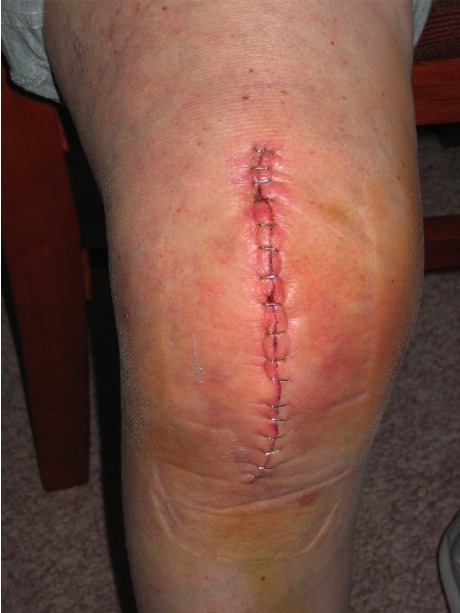
It’s no fun, really. And you’ll get stopped by airport security for a special check, every time.
Knee_Replacement2.jpg

Photo from Wikimedia Commons.

Here’s the advice from the National Institutes of Health––

How Can People Prevent Knee Problems?

Some knee problems, such as those resulting from an accident, cannot be foreseen or prevented. However, people can prevent many knee problems by following these suggestions:

Before exercising or participating in sports, warm up by walking or riding a stationary bicycle, then do stretches. Stretching the muscles in the front of the thigh (quadriceps) and back of the thigh (hamstrings) reduces tension on the tendons and relieves pressure on the knee during activity.

Strengthen the leg muscles by doing specific exercises (for example, by walking up stairs or hills or by riding a stationary bicycle). A supervised workout with weights is another way to strengthen the leg muscles that support the knee.

Avoid sudden changes in the intensity of exercise. Increase the force or duration of activity gradually.

Wear shoes that fit properly and are in good condition. This will help maintain balance and leg alignment when walking or running. Flat feet or overpronated feet (feet that roll inward) can cause knee problems. People can often reduce some of these problems by wearing special shoe inserts (orthotics).

Maintain a healthy weight to reduce stress on the knee. Obesity increases the risk of osteoarthritis of the knee.

What Types of Exercise Are Best for People With Knee Problems?

Ideally, everyone should get three types of exercise regularly:

Range-of-motion exercises to help maintain normal joint movement and relieve stiffness.

Strengthening exercises to help keep or increase muscle strength. Keeping muscles strong with exercises – such as walking up stairs, doing leg lifts or dips, or riding a stationary bicycle – helps support and protect the knee.

Aerobic or endurance exercises to improve function of the heart and circulation and to help control weight. Weight control can be important to people who have arthritis because extra weight puts pressure on many joints. Some studies show that aerobic exercise can reduce inflammation in some joints.

If you already have knee problems, your doctor or physical therapist can help with a plan of exercise that will help the knee(s) without increasing the risk of injury or further damage. As a general rule, you should choose gentle exercises such as swimming, aquatic exercise, or walking rather than jarring exercises such as jogging or high-impact aerobics.

So there it is, same old thing: exercise and lose weight. If you really really do not want a titanium and plastic knee, losing weight is probably the best thing you can do. “Data from the first National Health and Nutrition Examination Survey (HANES I) indicated that obese women had nearly 4 times the risk of knee osteoarthritis as compared with non-obese women; for obese men, the risk was nearly 5 times greater.” Moreover, if you already have knee pain, losing even ten pounds can significantly reduce both pain and the ongoing deterioration of the knee. Being only 10 pounds overweight increases the force on the knee by 30-60 pounds with each step. You don’t need to reach your ideal weight; any reduction will help. And maybe that will be encouragement enough to keep going, slowly, losing weight and feeling better. (Thorough discussion of weight loss and osteoarthritis, here.)
“Infectious” vs. “contagious”

Just because we’re all hearing about H1N1 flu, and these terms are being used a lot, here’s the difference:

Infectious

1. A disease capable of being transmitted from person to person, with or without actual contact.
2. Syn: infective
3. Denoting a disease due to the action of a microorganism.

Contagious

Relating to contagion; communicable or transmissible by contact with the sick or their fresh secretions or excretions.
[from Stedman’s online Medical Dictionary]

Anthrax, for example, is infectious but not contagious. It is caused by a microorganism, the bacterium Bacillus anthracis, but it’s not “communicable or transmissible by contact with the sick or their fresh secretions or excretions”. People most often get anthrax from contact with infected hides or other animal products, and from soil where the hardy spores of the bacterium can remain for decades after being deposited by infected animals. [Such spore formation is known in only a few bacteria.]

There’s some confusion inherent in these terms because it seems that the “contact with the sick or their fresh secretions or excretions” part only applies to sick humans. You might get rabies from breathing in droplets of the saliva of an infected animal, but that is not considered to be contagion. As near as I can tell, anyway. So, since a human being with rabies doesn’t infect others, the disease is considered non-contagious.

An important factor in any contagious disease is how easily it is transmitted from one person to another. You can’t get HIV from touching the skin of an infected person, but influenza and the common cold can be transmitted that way. Shake hands with someone who just sneezed into his or her hand, and the bacteria are on your hand; when you touch your mouth, nose or eyes, the microorganisms can enter your system. TB is contagious, as is leprosy, but they are not transmitted by brief casual contact.

Right now the question about H1N1 flu is, how contagious is it? And then, how fatal is it? Influenzas mutate rapidly so the virus which seems to have originated in Mexico may be changing to something different as it spreads. Hence the reluctance of medical officials to make predictions about what is in store for the world with this disease.

An early warning system for health threats: the invaluable work of ProMED

ProMED Mail is one of the most important information resources on the net, and most of us have never heard of it. It’s an email list which describes itself as a “global electronic reporting system for outbreaks of infectious diseases and acute exposures to toxins that affect human health, including those in animals and in plants grown for food or animal feed”.

Unlike the official clearinghouses run by WHO and CDC, ProMED is, in its own words, “open to all sources” and its reports are freely available to us all. ProMED was first to raise concern about the aggressive respiratory disease spreading in China in 2003, which became known as SARS. Before the Chinese authorities had permitted their officials to report the disease to WHO, Catherine Strommen, an elementary school teacher in Fremont, California, spotted a post in an international teachers’ chat room from a concerned teacher in China describing “an illness that started like a cold, but killed its victims in days”.

Alarmed, Strommen emailed an old neighbor and friend, Stephen Cunnion, M.D., a retired Navy physician and epidemiologist who now lived in Maryland. A practical, no-nonsense man, Cunnion started searching the web. With no success, he tried a new tack—sending an email to ProMED-mail, a global electronic reporting system for outbreaks of emerging infections and toxins. After quoting Strommen’s missive, he asked: “Does anyone know anything about this problem?”

The tiny ProMED staff conducted its own web search. It, too, came up empty-handed. On February 10, it sent out to tens of thousands of subscribers a posting headed: “PNEUMONIA – CHINA (GUANGDONG): RFI,” or Request for Information.

Thus did the world first learn of SARS, the new and deadly infection that would kill 774 people and infect 8,000 in 27 countries.

From an article by Madeline Drexler in The Journal of Life Sciences.

H1N1 Reports (Swine-avian-human Influenza A)

To keep up on H1N1 flu [I agree with the pig farmers, “swine flu” sounds like your big risk is getting it from pigs and pork, not human sneezes and handshakes] check the ProMED main page. While all the media is now frothing over with “news” about this disease, some of it sounds as reliable as alien abduction accounts. ProMED is timely and scientifically accurate but understandable by non-biologists. It includes valuable, and interesting, commentary on reports and questions: “this has been reported, but here’s what we don’t know, or here are local factors that must be considered in evaluating it”.

What ProMED does

ProMED is a program of the International Society for Infectious Diseases which began in 1994. It does not simply print whatever comes in—this is an extremely well-moderated list. A group of specialists checks and filters the reports, seeks more information from local sources and other experts, and provides judicious commentary. This group also “scans newspapers, the internet, health department and government alerts, and other information sources for inklings that an infectious disease, perhaps not yet reported widely, is threatening animal, plant and/or human health.”

I think I first signed up to receive the digests back when “mad cow disease” was emerging, and have since used ProMED to follow diseases such as anthrax and Ebola.
A topic of interest to me recently concerns outbreaks of measles and mumps in Western nations due to falling rates of vaccination. And as a former zookeeper I keep up on diseases of wildlife and zoo animals, including the fungal disease threatening whole populations of wild bats in the Eastern US. ProMED also covers plant diseases (mostly of crops).

All of this, infectious diseases of humans, wildlife, and crops, is of greatly increased urgency because climate change, global transport, and destruction of wild areas all lead to the spread of familiar diseases to new locales and the emergence of “new” diseases previously only found in remote wild areas. With regard to contaminants and toxins, governments are unable to deal with this effectively due to the political power of corporations and lack f oversight in producing countries. ProMED can’t make your food and furniture non-toxic, but it can sound alarms that might otherwise be silenced.References to a topic’s prior appearances on the list are attached to current reports, and archives are easy to access. Editions in French, Portuguese, Russian and Spanish are now available.

“Each posting is limited to 25 KB bandwidth—to ensure that it slips through an old-fashioned dial-up modem in the most remote areas of the world (where new infectious threats tend to smolder). ‘We use technology that was state-of-the-art in 1994. We use email—plain-text email at that. We don’t use fancy fonts,’ Madoff says. ‘The power of the Internet is its ubiquity and speed; it’s not necessarily in all the neat things you can do.’ [from Drexler’s article cited above]

You can subscribe here.

Toxins and contaminants

ProMED also collects, evaluates, and disseminates reports of health problems related to toxins and contamination of food and medicines. These can be quite unusual. For example, the case of the toxic leather sofas in Britain:

toxicsofaleg.jpg

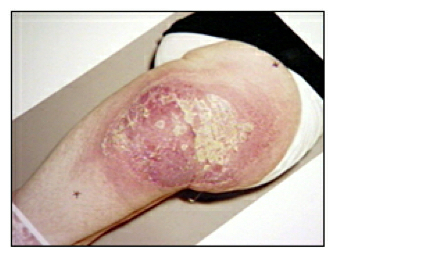
Photo: Effect on leg of reaction to toxic chemical contained in sofas. From BBC.

A judge [in the UK] is expected to order several retailers to pay millions of
pounds to people who suffered burns and rashes from faulty leather
sofas….

More than 1600 people claim to have been affected by the problem. Tens
of thousands more people could have burns not yet traced to sofas.
The High Street stores, along with 11 others, may have to pay more
than 10 million pounds [USD 14.3 million] in compensation and legal
costs, the shoppers’ lawyers say. They claim that makes it “the
largest group compensation claim ever seen in British Courts.”

The sofas, which were manufactured in China, were packed with sachets
of an anti-mould chemical called dimethyl fumarate to stop them from
going moldy during storage in humid conditions.

Commonly known as DMF, the toxic, fine white powder has been used by
some manufacturers to protect leather goods like furniture and shoes
from mold. Even very small amounts can be harmful.

One sofa customer, who is well aware of the health problems caused by
her purchase, is a customer who bought a leather sofa suite from
Argos in April 2007. Almost a year later, she started to notice a
rash developing on her arms and legs. After a few weeks, her skin
started flaking off. She says the irritation was so bad, she was off
work for 2 months. This customer was seen by more than a dozen
doctors, who couldn’t work out what was causing the rash.

She said: “It was very, very painful; I couldn’t sleep at night; I
couldn’t walk about; I couldn’t drive; every time I did walk about,
the skin would fall off, and I would leave a trail of it, therefore,
I couldn’t go to work.”

Reliable histories of outbreaks/events

ProMED doesn’t just present breaking news and requests for additional reports; it frequently publishes very useful summaries of what’s been learned, and what action governmental agencies have taken. For example, “Melamine contaminated food products – Worldwide ex China” and “Prion disease Update 2009 (01)” (Mad Cow Disease and its human infectious disease, the fatal “variant Creutzfeldt-Jakob disease”.

Supporting ProMED

Believe it or not, ProMED is supported by individuals, with not a penny of funding from any government. That means they are independent (remember the movie Jaws, where the city council wants to suppress news of the shark attacks?) and fast to react. They sift a lot of news from all sorts of sources, put out calls for more information, and disseminate news in a responsible way.

If the work of this group seems like something you’d like to support, here’s your chance. They’re having a brief Spring fundraising campaign. To quote their email,

Your gift funds quick information every day – The economical, low-tech computer programs we use enable us to speed ProMED to your mailboxes, to post it online where anyone can find it, , and to provide the administrative services (accounting, office space, cell phone connections, etc.) required to support a small, agile worldwide enterprise.

ProMED-mail reaches over 50,000 public health officials, students, journalists, agricultural specialists, infectious disease professionals and others around the globe. Because it is free, subscribers in more than 187 countries have an equal opportunity to know when a disease outbreak occurs — and can spring into action when necessary to prevent or minimize its spread.

If the Spring campaign is past, here’s the main donations page.

Puppy Mills and Pit Bulls––is legislation the right approach?

In my state of Oregon there are two pieces of dog-related legislation currently being considered. HB 2470 is supposed to address puppy mills, HB 2852 is ostensibly aimed at increasing public safety from “dangerous dogs”.

These goals are hard to disagree with, but the details of both bills are such as to cause concern in people who know and love dogs.

HB 2470, the “Puppy Mill” Bill

The first, for example, contains a so-called “lemon law” provision giving puppy buyers legal recourse against sellers if:

Section 5 (1) (b) Within two years after the customer acquires the dog, a veterinarian states in writing that the dog has, or that the dog died as a result of, a congenital or hereditary defect adversely affecting the health of the dog or requiring hospitalization or nonelective surgical procedures.

The buyer is entitled to reimbursement for vet expenses up to 100% (or in some cases 150%) of the purchase price of the dog) in combination with returning the dog for a full refund, exchanging the dog for another, or keeping the dog.

This sounds fair and workable at first glance, but the greatest problems of illness and unsoundness come from dogs bred by backyard breeders (“Hey, my female Lab is in heat, your male looks good, let’s introduce them and sell some puppies!”) and from actual puppy mills that mass-produce dogs for profit. Neither of these is likely to pay up willingly (puppy mills sell to pet stores through nation-wide brokers, so there is some doubt about even identifying the breeder of a specific puppy). Then the dog owner has to go to court for the $350?

Reputable breeders work hard to eliminate the known genetic flaws from their breed and from the puppies they produce; often, they also have buyers sign a contract in which the buyer promises to contact the breeder at any time if unable to keep it. The breeder wants to be consulted on suitable re-homing, and to be the home of last resort if no suitable home can be found. Good breeders love their dogs; they want to keep them out of shelters and bad homes. Breed enthusiasts operate rescue programs for their breed, for the same reasons.

If a dedicated breeder has done due diligence in genetic choice of a breeding pair, had all the tests done, monitored the dogs for heritable defects, and still at age one year a puppy develops a genetic fault, shall we hold that person as liable as some for-profit breeder who has done none of those things?

My observation has been that the only way to make money from breeding dogs is to go the backyard breeder/puppy mill route: low overhead, no varying of breeding stock but using the animals at hand, dogs kept in low-rent conditions (the way dogs are housed and kept at puppy mills would make a stone weep), minimal vet care, and sell everything you breed without testing, socialization, screening buyers, or making guarantees.

HB 2852: Your dog may be labelled a “dangerous dog”

The second bill, HB 2852, is in large part what’s known as “Breed-Specific Legislation”. The Feb, 24, 2009 version actually forbade future ownership of pit bulls and lookalikes, with big fines and euthanasia as penalties, and required special permits and insurance for current owners. The revision, after great outcry, requires owners to carry $1 million in mandatory liability insurance coverage (“failure to prove compliance with order punishable by maximum fine of $720 per day”).

And other provisions would have drastic consequences for all dog breeds by broadening definitions of “dangerous dogs” which are subject to court-ordered restrictions, insurance requirements, and even euthanasia. As far as I can tell the bill still contains a provision under which “menacing” a person, off your property, for “no good reason”, can result in classification as “dangerous” and result in court-ordered insurance and enclosure requirements or even euthanasia. What constitutes “menacing”? A growl, a lunge?

This bill is opposed by the Oregon Veterinary Medical Association; they oppose all breed-specific legislation, I am told.

In brief, the objections to Breed-Specific Legislation (BSL) are:

• vagueness of identifying the breeds subject to the law
• increasing the “outlaw” cachet of some breeds which are already being abused by dogfighters, criminals, and garden-variety macho dog owners who acquire them as ego accessories
• using scarce public resources against a single breed rather than supporting the public education which is the most important element for increasing public safety with regard to dogs, as well as for reducing abuse of dogs

Vagueness of identifying the breeds subject to the law

Vagueness helps accomplish the real aim of BSL, which is to eradicate certain breeds. This bill defines “pit bull” as

(b) ‘Pit bull’ means a dog that:

(A) Is registered or otherwise listed as an American pit bull
terrier, Staffordshire bull terrier or American Staffordshire
terrier with a dog breed club or league, dog fanciers
association, breed registry or similar organization; or

(B) Has appearance and physical characteristics that
substantially conform to the breed standards of the United Kennel
Club for an American pit bull terrier or of the American Kennel
Club for a Staffordshire bull terrier or American Staffordshire
terrier, as those standards existed on January 1, 2009.
[Section 1 (b), HB 2852]

This means that shelters will euthanize any dogs that could possibly be seen as “bullish” whether they look pure-bred or are mixes. They’ll be unadoptable and potentially a legal liability. Present owners of dogs that are pit bulls, or resemble them, will be in a quandary: get expensive insurance, risk huge liability if any incident occurs (your dog accidentally knocks over a child, or bites a person teasing him), or get rid of their dogs. Some estimate that at least a dozen different recognized dog breeds could fall into the loose definition, which will be applied in individual cases by someone with no special knowledge (a judge, a policeman, your neighbor).

In the city and county of Denver, where pit bulls have been illegal since 1989, Denver’s Division of Animal Control impounded 689 pit-bull-looking dogs in 2003. “All we can do is say what they look like,” said the Director of the Division. Since enforcement got serious in 2005, 1,667 dogs have been euthanized because they appeared pit bull-like.

Increasing “outlaw” cachet and macho accessorizing

What else needs to be said about this?

Re-directing public resources and attention

It’s easy to pass feel-good legislation, much harder to do what is necessary to truly address a problem. As far as dog safety goes, the problem is not the breed but the owner. And also those breeders who produce dogs without regard for temperament or overall health (including truly evil people who breed dogs, and abuse dogs, in order to make vicious creatures).

Both of the bills described above would be expensive to enforce. When Joan’s boxer mix is impounded, she sues the county: Prove he’s a pit bull! And the “puppy mill bill”, HB 2470, sets out specific rules for how dogs are kept by individuals that breed or sell a certain number of puppies per year; that’s great, but it is meaningless without enforcement. In this economic climate, the idea of adding county staff to investigate or inspect dog breeders is laughable.

Singling out specific breeds

Pit bulls do have very strong jaws, and were bred for fighting, but also for lack of aggression to humans, since in a fighting bout, humans in the ring separate the two dogs by hand. In addition, recent decades of breeding for stable companion dogs has created pit bulls that are gentle companions. The methods of those who train dogs today for fighting are savage, including starvation combined with feeding them small live animals, beating, and electrical shocks. Would this be necessary, if the average “bullish” dog were by nature an eager fighter and savage killer?
About half of the 51 brutalized dogs seized from Michael Vick’s Bad Newz Kennels have been evaluated and placed in permanent or foster homes; some have achieved Canine Good Citizen certification and a few are working as therapy dogs. The other half were judged too dog-aggressive for adoption, and sent to a special facility where most are now judged quite safe for staff and visitors to mingle with. Some of the 51 had been used as fighters, others––less eager to fight––as “bait dogs” for the others to “practice” on. Yet of them all only one was judged irredeemable and euthanized. [For details, see long Sports Illustrated article, one-page version here, and also a Washington Post article .]
Outlawing specific breeds such as pit bulls [American pit bull terriers, Staffordshire bull terriers or American Staffordshires] or Presa Canarios would have little effect on numbers of dog bites—dog bite statistics are not very exact. The intent of breed bans is generally to reduce the number of serious and fatal dog attacks; the powerful jaws and tenacity of pit bulls, PresaCanarios, Rottweilers, and a few other breeds seem very threatening. Yet the American Animal Hospital Association has this to say on the issue:

A study performed by the American Veterinary Medical Association, the CDC, and the Humane Society of the United States, analyzed dog bite statistics from the last 20 years and found that the statistics don’t show that any breeds are inherently more dangerous than others. The study showed that the most popular large breed dogs at any one time were consistently on the list of breeds that bit fatally. There were a high number of fatal bites from Doberman pinschers in the 1970s, for example, because Dobermans were very popular at that time and there were more Dobermans around, and because Dobermans’size makes their bites more dangerous. The number of fatal bites from pit bulls rose in the 1980s for the same reason, and the number of bites from rottweilers in the 1990s. The study also noted that there are no reliable statistics for nonfatal dog bites, so there is no way to know how often smaller breeds are biting.

Whatever the breed, the role of the owner in choosing, training, supervising, and caring for the dog is in my opinion the main reason that such attacks happen. Unscrupulous or ignorant breeders, who do not screen for temperament and health problems, and do not exercise care in placing puppies, are the second greatest cause.

I would love to see some of this bill’s provisions enacted and enforced everywhere: a limit of (in the current version) 25 intact sexually mature dogs per premise––personally I think that is too many but it is a start––and rules about care, housing, exercise, and health. As long as the rules are enforced fairly, and defined with regard to the varying circumstances of breeders, it improves the care of the dogs. An example of taking into account the varying circumstances of breeders: the bill requires that anyone with 10 or more sexually intact dogs over 4 months of age must provide each dog with an enclosure meeting certain requirements. One can imagine, especially with smaller dogs, someone who might have 10 dogs that do not even have individual enclosures, but are in the house and outside in a single large run or big fenced property; the bill seems to require that the breeder be able to point to some individual kennel for each of the ten dogs.

In the next post I’ll make some suggestions for a better approach to these issues, something that we dog owners can do ourselves.

For now, if you live in Oregon, please contact your legislators about these bills. At the National Animal Interest Alliance site you can send an email to your legislator about the Puppy Mill Bill, HB 2470; they also offer more information and suggested points to mention. To oppose the Pit Bull/Dangerous Dog legislation, cite HB 2852; there’s a state form here to identify your district’s legislators and get their email addresses. This page also gives contact information for your US Senators and Congressional Representative.

For readers who live elsewhere, the NAIA site has legislative alerts for national legislation as well as in each state. Sign up for alerts; see legislation in your state (don’t click on the map, go down farther and click on the link for your state). The AKC also has a legislative-watch page. Scanning these pages shows just how active the efforts are across the country, to enact restrictive and breed-specific legislation about dogs.

Letters to local newspapers setting out the actual provisions and consequences of proposed legislation are another way to oppose these bills. If legislators feel that their constituents are fooled by the beneficial titles (“Anti-Puppy Mill” or “Control Dangerous Dogs”) they don’t dare vote against them or support amendments.