New tactic may deter tailgating drivers

Yesterday I may have made a great discovery. I have to test it some more but given its earthshaking importance for our American culture I feel obligated to reveal it so others may test it also.

On our rural roads, there is not a lot of traffic, but there are always tailgaters. Guys with mustaches in giant pickups (always alone, truck bed always empty, does this tell us something?), people late to work or late getting home from the bar, and those who just have to be in front even though it is not feasible to go much faster. They bug me. I used to slow down deliberately to frustrate them, and even, I blush to relate, touched my brakes unnecessarily a few times when they got too close, to scare them into backing off.

In my own defense, on these roads there are commonly events that require fast stops or slowdowns, such as deer in the road, bicyclists ditto, and (that other class of aberrant drivers) people coming around a curve on the wrong side of the road. But I listened to the voice of reason (“You irritate one of these yo-yos too much and he’s liable to shoot you or force you off the road!”) and quit the punitive slowing and braking. Samuel L. Goldwyn was right, as usual, when he told us to utilize Western Union if we wanted to send a message.

In my new incarnation as rational long-suffering driver I used my familiarity with the road to pull off and let the yahoos pass me, then I might snarkle and impugn their intelligence, but not so as they would ever notice. Or, if feeling calm and compassionate, I would speculate sympathetically on what emergency forced them to drive in this manner: wife in labor, relative just been in a car wreck (ironic, that), pre-occupied with impending financial ruin due to high insurance premiums. Stuff like that.

But, as so often in this life, it was when I was not thinking about the issue at all, and in fact was feeling good and enjoying uplifting music in the car, that I stumbled upon what may be the great discovery.

The music was Tchaikovsky’s First Violin Concerto–one of those stirring “old war-horses” of the classical repertoire, and I love it. Itzhak Perlman was going at it, and some parts just made my body and soul leap up. Must have had more energy than usual because soon I was “conducting” vigorously with my right arm while driving with my left. I’ve always been prone to this, when driving alone with the right music, but it had been a while. The music called for lots of conducting, or let’s be real, rhythmic arm-waving and hand-pointing. I was having a great time. But I was not neglecting my driving, and soon I noticed in my rear-view mirror that the car behind me which had been not exactly tail-gating but close, had dropped way back. After he turned off, the next car that came up also dropped way back. I could hear their thoughts: “This loon has flipped out completely! Give her some space!”

So there it is, my discovery regarding tail-gating, inhibition thereof.

Tchaikovski.jpg

Here’s Tchaikovsky giving the evil eye to tail-gaters! [Painting: Pyotr Ilyich Tchaikovsky by Nikolay Kuznetsov, 1893. Source Wikipedia.]

Of course there are some warnings to be issued. If you can’t walk and chew gum at the same time you should not try this, and probably you should not be driving anyway. Results are not yet in on fMRI brain scans to see if this activity interferes with driving attention as much as, say, cell phone usage, but I’ll get back to you on that. Also, imitating a conductor is strenuous (ever noticed how long conductors live? it is a very healthy profession, judging by longevity [1]) and you may see unequal muscle development on the arm used.
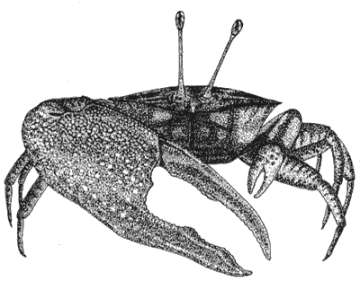
fiddlerCrab.jpg

Fiddler crab, scientific illustration (artist unknown) from the Association for the Study of Animal Behaviour. They may be studying me next!

It is possible to switch arms, but there isn’t enough space on the driver’s door side to give full rein to your enthusiasm. Using both arms at once is not recommended and may attract attention from the police. We never see any out where I live so no worries there.

Finally, I am not a driving expert, a real conductor of orchestras or even trains, nor an attorney. But I can recommend that you check out the music of Beethoven, Rachmaninoff, Dvorak, as well as Tchaikovsky, for music to drive by. Even if you keep both hands on the wheel and just listen, it is a good distraction from–well, anything you need distraction from: except of course your own safe driving.

[1] That little fact-checker that lives in my brain is such a nuisance! I’ve believed this about conductors’ living long lives, probably due in part to the exercise of arm-waving, since I was in high school, but as I was putting it in writing I felt obliged to check it. Sadly, I found good reason to doubt it. See Spurious Correlations by William C. Burns. The major objection seems to be that

…there is a subtle flaw in life-expectancy comparisons: The calculation of average life expectancy includes infant deaths along with those of adults who survive for many years. Because no infant has ever conducted an orchestra, the data from infant mortalities should be excluded from the comparison standard. Well, then, what about teenagers? They also are much too young to take over a major orchestra, so their deaths should also be excluded from the general average. Carroll argued that an appropriate cutoff age for the comparison group is at least 32 years old, an estimate of the average age of appointment to a first orchestral conducting post. The mean life expectancy among U.S. males who have already reached the age of 32 is 72.0 years, so the relative advantage, if any, of being in the famous conductor category is much smaller than suggested by the previous, flawed comparison.

Quoted from Statistics as Principled Argument, by Robert P Abelson

cut_tumblingBoys.jpg

We were carefree and having such fun…

cut_constables.jpg

Until those stuffy old fact-checkers came along! [Both of these delightful “cuts” are from the blog BibliOdyssey, a treasure trove of antique illustrations and ornaments. Thanks to ‘peacay’ for his work in finding them and putting them online (and to his other contributors too).
Keeping deer out of the garden

Deer love tender new leaves and can leap tall fences at a bound. We see them all the time, on our rural property outside the fenced area where the dogs have free range. But we’ve never had one get into our vegetable garden which is bordered on the back by that main fence, and on the other three sides by fences to keep our dogs out. The fences are well under five feet tall, nothing for a deer to jump. Our garden is in raised beds about three feet wide and varying in length; between the wooden sides of the beds, the walkways are about two and a half feet wide. My theory is, that deer (like other hoofed animals) are concerned about having good footing when they jump into a place, and the narrow spaces and mixture of heights doesn’t look safe or inviting.

Outside our fence I have been trying for over eight years to get trees and tall plants established in a bare spot to make a visual barrier between us and our neighbor’s two-story place. Poor soil and hot dry weather have been the major problem, but then the deer have chowed down on most everything that I have kept alive except some weeping willows I started by sticking branches in the ground. I’ve tried old remedies, new remedies, and wacky ideas: Mylar pinwheels, hanging scented soap, rotten egg spray, flapping hanging things tied to the trees, systemic bittering agents put in the soil, glittery hanging things like metallic beads, Mylar streamers, and aluminum pie plates (reputed to work to repel birds eating ripening fruit). Never did try hanging little bags of human hair trimmings, a method with a following. I bought dehydrated coyote urine but then on the drive home thought about how it must have been collected, and went back and returned it with an explanation to the wild bird store, and I believe they stopped carrying it. It might have worked, but the confinement needed to produce it was unacceptable.

I went so far as to lay down landscape cloth around the trees and then on top of that peg down that plastic-netting fencing used for temporary barriers. I put it down horizontally: it did a good job of tripping me up all the time but the deer did not seem to be affected. And soon falling leaves covered it, weeds rooted in the decomposed leaves, and it was buried.

Finally I decided to mimic what worked in the garden and I used wide plastic tape, like crime scene tape or the fiberglass tape used on drywall seams, to divide the tree area into many narrow portions. It worked! I put it at varying heights between 2 – 4 feet, going around a tree trunk or stake and then off at an angle to another point. I’ve now moved to using bright yellow polypropylene rope because the tapes didn’t hold up to uv exposure, and the stronger rope is easier for me to get over or under when working out there. Once the trees get tall enough, it can be removed; without some protection, nothing but the original willows will ever get that tall. It’s not too scenic, but I don’t care, and the neighbors–I think they probably prefer it to the flapping plastic trash bags!

Remedies for poison oak, poison ivy

I’m as allergic to poison oak as anyone I know; I’ve “gotten” it even from contact once removed, from the coat of a dog, someone else’s hand or jacket. The swelling and itching is very bad: eyes swell shut, skin won’t tolerate clothing. I’ve found two things that work better for me than anything else.

For the itching, take antihistamines. These work also for relieving the itching of mosquito bites.

For the swelling, and to make the poison oak lesions dry up and go away faster, try Neutrogena’s Body Clear Body Scrub. Put it on the affected areas generously and gently (do not scrub) and let it sit for 3 or 4 minutes before rinsing. One application usually is enough; if not repeat after a few hours. The active ingredient is salicylic acid, 2%, meant to dry up oily skin, but for me it has been extremely effective at reducing swelling and itching, stopping “weeping” from the lesions, and making them heal in perhaps half the usual time. I expect that other preparations with similar content of salicylic acid would work too, as long as no other ingredient irritates the poison oak blisters, but this is the only one I have tried. I keep a bottle just for poison oak season, year after year.

The active ingredient that causes the allergy is urushiol, and as far as I know it is the same in all three species of poison oak and ivy, so this remedy should help in all cases. The fact that the condition is an allergy, not a case of “poisoning,” explains why reactions vary among individuals and even in the same individual. A person previously non-reactive can develop the allergy after any number of exposures.

Disclaimer: I’m not a doctor, nor do I have any financial interest in Neutrogena.

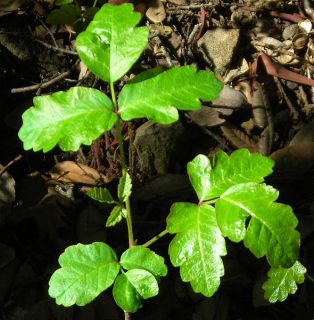
Images below from Wikipedia: left, glossy new spring growth of Western or Pacific poison oak (Toxicodendron diversilobum, also called Rhus diversiloba. Brand-new spring foliage is sometimes crimson.
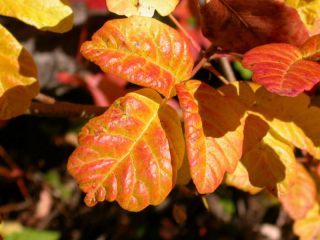
Right, the attractive fall colors.

poison_oak1.jpg

poison_oak2.jpg

Don’t count sheep

sheep_wikimedia.jpg

I never understood how counting sheep, which I envisioned as anonymous fluffy white things, could possibly help one get to sleep. After I devised my own “counting” system for getting to sleep, I saw how it worked––but I think my method works better for those of us who are not actual flock-owners. I’d bet the figure of speech referred to one’s own sheep; livestock owners and wranglers can tell one sheep (or cow, or goldfish, or goat) from the others, and often name them. So lying in bed mentally counting your own sheep, “Old one-horn, Bent-ear, Mamma, Groucho, Blackie…” would be just like my system. But if you lack a herd of animals to count, try this:

Choose some category you’re fairly knowledgeable about. Baseball players, dog breeds, varieties of roses, countries of the world, band names, English poets, herbs and spices, whatever. Now, start naming them one by one, by letter of the alphabet. I do dog breeds a lot: Akita, Border Collie, Chesapeake Bay Retriever, Dachsund, English Mastiff….and I have never gotten past the letter “R” before falling asleep.

If you choose a “closed group,” like States of the US, you’ll have to count on your fingers to be sure you end up with the right number. I just use the fingers of one hand for the new additions, counting up to 5 and then starting again, and seem to be able to remember the total, as in “I’ll be adding these new ones to 15”. But you could use the fingers of the other hand (twice) to track finished groups of five. If I were to arrive at Wyoming and before reaching 50, then I would have to start over.

How does this work? Seems likely it is by making the mind concentrate its energies on something that has no emotion connected with it. If you just lie there and think, it is probably your thoughts that will interfere with sleep, because you’ll get into planning, worrying, anticipating, remembering, and that disturbs the gradual relaxation need for sleep.

I’ve been using this method for 20+ years, when I started planning in my mind which roses to buy and where to plant them. It can work despite some degree of physical pain or mental distress, but at some point these will defeat it. (When I said, “I have never gotten past the letter “R” before falling asleep,” I should have added that on those occasions when pain is so great that I can’t get into my concentration by about “M”, I get up out of bed. Often it helps to sit in the living room until I feel cold––getting warm in bed then relaxes me and I can sleep. Or, I read for a while and try again.) However, the technique is easy, free, portable and always available, and has no side effects or addictive potential.

When you’ve used this method for a while it becomes a soothing routine associated with sleep and that helps too.

For best results

Stack the deck in your favor by following the experts’ familiar advice: avoid exercise, heavy meals, caffeine, and excitement for several hours before sleep; keep your bedroom a comfortable temperature; don’t watch TV in bed; use a fan or other white-noise generator.

Before I start naming or counting I relax for a minute by simply making my body feel heavy, as if it is sinking deeper & deeper into the bed. I’ve tried progressive relaxation (make your toes feel relaxed and warm, then your ankles, etc.) but I cannot concentrate enough to keep out whatever thoughts or sensations are keeping me awake.