On July 4 in the US we celebrate the adoption of the Declaration of Independence by the Continental Congress in 1776; we should also celebrate December 15, 1791 when the Bill of Rights came into effect after being ratified by three-quarters of the states.
Two events reported this week got me thinking about civil liberties.
Court orders Google to release information to identify all YouTube viewers
Viacom has been suing Google, owner of Youtube, alleging that Youtube has acted “as a willing accomplice to Internet users who put clips of Viacom’s copyrighted television programs on the popular video-sharing website.” Google tried to resist Viacom’s “request for data on which YouTube users watch which videos on the website in order to support its case in a billion-dollar copyright lawsuit against Google.” Google maintained that “the data should not be disclosed because of the users’ privacy concerns,” citing the (Video Privacy Protection Act) VPPA, 18 U.S.C. § 2710 but US District Court Judge Louis Stanton, San Francisco, found in favor of Viacom and ordered Google to release to Viacom “all data from the Logging database concerning each time a YouTube video has been viewed on the YouTube website or through embedding on a third-party website.”
How many people does this affect? In January 2008, nearly 79 million users used YouTube, making over 3 billion video views. Over 80 million videos are hosted on YouTube, uploaded by users. Not bad for a business founded in 2005, which Google says makes a “negligible” profit. (from Wikipedia.)
Handing over the identifying information on 79 million distinct users is a huge breach of privacy, and unjustifiable given that a study of videos removed from YouTube at the request of copyright holders found that only 2% of them were from Viacom.
Google was apparently hoist by its own petard, having previously claimed in a blog post, titled “Are IP addresses personal?”, that “We . . . are strong supporters of the idea that data protection laws should apply to any data that could identify you. The reality is though that in most cases, an IP address without additional information cannot.” The judge evidently reasoned that this made release of the data acceptable despite restrictions of various federal legislation concerning electronic privacy. Many of the comments posted in response to this post disagree. It seems that people using home computers, as opposed to mobile laptops, are particularly likely to be identifiable.
Will this ruling begin another round of lawsuits against individuals, like those filed by the Recording Industry Association of America over music downloads? Seems very possible.
But of more concern is the breach of the principle of the Video Privacy Protection Act of 1988. The VPPA
was passed in reaction to the disclosure of Supreme Court nominee Robert Bork’s video rental records in a newspaper. The Act is not often invoked, but stands as one of the strongest protections of consumer privacy against a specific form of data collection. Generally, it prevents disclosure of personally identifiable rental records of “prerecorded video cassette tapes or similar audio visual material.” [see information at EPIC, the Electronic Privacy Information Center]
The Patriot Act, of course, trumps everything, from the Bill of Rights to the VPPA, but legally it can be considered (and I hope that day comes soon) as ad hoc legislation to meet a temporary need, or perceived need; as something to be retired after the need, or the panic, or the madness, has subsided. When privacy legislation––not passed in response to a specific political crisis––is bypassed or invalidated, that loss may be permanent.
But it’s worse in Britain
Britain may have pushed things along, in the civil liberties, field, with the Magna Carta in 1215, but they never got around to anything like a Bill of Rights. So citizens there have much less legal basis to protest violation of their rights by a government bent on reforming behavior and cracking down on terrorism.
Habeas corpus?
The British government recently extended the period for which it could hold terrorism suspects, without charges, to 42 days. In a recent public debate, the new law was criticized on pragmatic grounds: “The problem with 42 days is we keep innocent people for longer than we do guilty ones,” said House of Commons member David Davis, because those with clear evidence against them were charged first. That, he said, did nothing to encourage “moderate Muslims” to help counterterrorism operations. Davis is resigning his MP position in order to force an election for the seat; he will run (or “stand,” as they say there) and he promises to make threats to civil liberties a central issue of the election.
Watching everyone
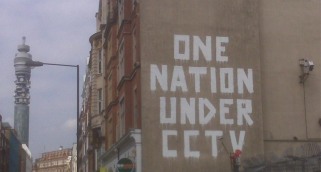
Britain has gone into video surveillance in a big way; the BBC presented the finding of a report, that in 2006 there were “are up to 4.2m CCTV cameras in Britain – about one for every 14 people.” The BBC cited another report issued about the same time, from the human rights group Privacy International, which found that “figures suggest Britain is the worst Western democracy at protecting individual privacy.” The two worst countries in the 36-nation survey are Malaysia and China, and Britain is down there with them in the bottom five because of “endemic surveillance”. Must be pretty safe there, you’d think. Wrong. Some liberals in the London city government used their Freedom of Information Act to get crime statistics: London has 10,000 closed-circuit TV cameras for crime fighting––costing 2 million pounds––but 80% of crime goes unsolved, and districts with more cameras don’t do better than those with fewer.
Recently their CCTV cameras became even more Robocop-like:
Britain is already one of the most watched nations on earth and now “talking” CCTV cameras are to be installed in 20 areas across the country. Britain is believed to have 20 per cent of the world’s CCTV cameras already. The loudspeakers will allow CCTV operators to bark orders at people committing anti-social behaviour.
Photo from Global Security Challenge. (I assume the painter is covering up this anti-social graffiti, or maybe he is the graffiti-ist himself, caught on camera.).
The neighbors are complaining about you…Off you go, then.
Since 1999 the British government has made use of Anti-social Behaviour Orders or ASBOs to control a wide range of behaviors
Anti-social behaviour has a wide legal definition – to paraphrase the Crime and Disorder Act 1998, it is behaviour which causes or is likely to cause harassment, alarm or distress to one or more people who are not in the same household as the perpetrator. Among the forms it can take are:
graffiti – which can on its own make even the tidiest urban spaces look squalid
abusive and intimidating language, too often directed at minorities
excessive noise, particularly late at night
fouling the street with litter
drunken behaviour in the streets, and the mess it creates
dealing drugs, with all the problems to which it gives rise. [from a Home Office page]
ASBOs are civil, not criminal actions against an individual and thus the individual doesn’t have the procedural safeguards––being charged, evidence being produced, and so on––that go along with criminal actions. What is the impact of an ASBO?
They stop people from doing stated things or going to stated places. They last for a minimum of two years, but can last longer. Those given ASBOs can be ‘named and shamed’ in local media, and sometimes are. Orders have been granted for abusive behaviour, vandalism, flyposting, and harassment as well as more the more celebrated exotic problems such as elderly people incessantly playing gramophones. Whilst ASBOs are civil orders, criminal penalties can result from breaching them.
Students can be barred from attending school, individuals can be banned from a certain area, or required to agree to a contract banning certain behaviors such as graffiti, rowdiness, drunkenness, or being too noisy. Violation of the contract can have criminal penalties, even though the justification for the ASBO itself was never tested or proved.
And how is this “Criminalisation of Nuisance,” as one author titled his book on ASBOs, working? Once again, not too well, it seems. “Hooliganism” is still common, and in 2006 a year-long study in England and Wales found that half the Asbos were broken, and “some teenagers saw them as glamorous….an Asbo was now viewed as a “diploma” that boosted a child’s street credibility. “Some of the friends are left out now because they are not on an Asbo,” said the mother of three young men who were all on Asbos.” Moreover, the report was published on the same day that “a separate study by the Institute for Public Policy Research suggest[ed] Britain’s youth are among the most badly behaved in Europe.”
So, if all this tough action by the British government is just as effective as requiring American travelers in airports to take off their shoes, and randomly surrender their laptops for two weeks…what purpose is being served? Ah, I wouldn’t care to say, could be hazardous to my liberty. Here’s to the Bill of Rights, and a citizenry wise and bold enough to defend it.
Photos from Breakthroughgen.org.



 nosleepingdogs