Stooks and sheaves at an historic farm

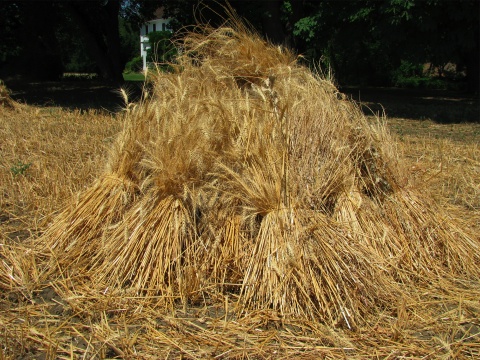
At Hanley Historic Farm near Jacksonville, Oregon, we came upon a wheatfield that had been cut and stacked, and it was a beautiful sight.

StooksField1.jpg

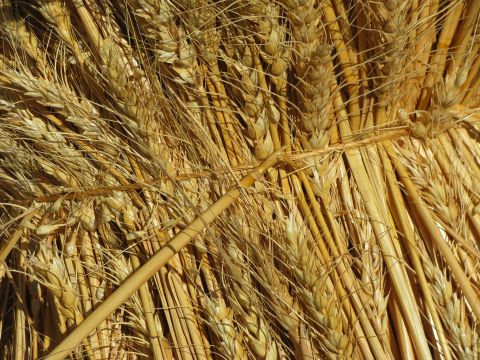
These aren’t just bunches of cut wheat tossed up into heaps like our idea of a haystack; they’re carefully constructed of sheaves, or bundles,

StookSingle.jpg

Stooks1V.jpg

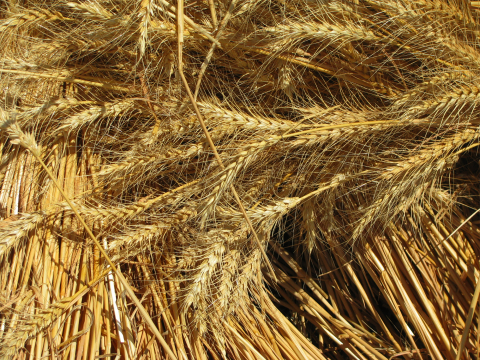
and each sheaf is self-tied with wheatstraw.

SheafTied.jpg

This takes us back a hundred and fifty years or so: before mechanical harvesters and threshers, grain was cut with scythes, made into stacks in the field to dry, heaved up onto wagons with pitchforks, and then threshed and winnowed to separate the wheat (or barley or oats or millet) from the chaff and straw. Hot, dusty, backbreaking work.

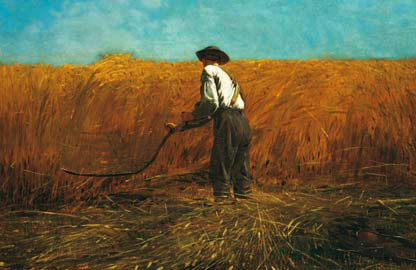
WinslowHomerThe_Veteran_in_a_New_Field1865.jpg

Winslow Homer (1836-1910), The Veteran in a New Field, 1865 (source)

ScythingPainting.jpg

(source; artist unknown.)

Think about cutting acres of wheat this way, stopping every 20 minutes or so to sharpen the scythe blade which had to be razor sharp so that the cut wheat would fall neatly.

Loading-The-Hay-Wagon-1.jpg

Heinrich Bürkel (1802-1869), Loading The Hay-Wagon [and hurrying to beat that rainstorm!] (cropped for this use; entire painting here)

StookCloseup1.jpg

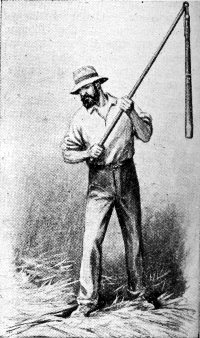
I’m curious how this wheat will be threshed and winnowed. Historic methods for threshing included having oxen walk round in circles stepping on the grain to break it (mentioned in the Bible: “You shall not muzzle an ox while it treads out the grain” Deuteronomy 25:4) and using a flail,

StookManWithFlail.jpg

Source

I’ll see what I can find out from the farm, which is run by the Southern Oregon Historical Society.

StooksFarmhouse.jpg

StooksHanleySign.jpg

An early warning system for health threats: the invaluable work of ProMED

ProMED Mail is one of the most important information resources on the net, and most of us have never heard of it. It’s an email list which describes itself as a “global electronic reporting system for outbreaks of infectious diseases and acute exposures to toxins that affect human health, including those in animals and in plants grown for food or animal feed”.

Unlike the official clearinghouses run by WHO and CDC, ProMED is, in its own words, “open to all sources” and its reports are freely available to us all. ProMED was first to raise concern about the aggressive respiratory disease spreading in China in 2003, which became known as SARS. Before the Chinese authorities had permitted their officials to report the disease to WHO, Catherine Strommen, an elementary school teacher in Fremont, California, spotted a post in an international teachers’ chat room from a concerned teacher in China describing “an illness that started like a cold, but killed its victims in days”.

Alarmed, Strommen emailed an old neighbor and friend, Stephen Cunnion, M.D., a retired Navy physician and epidemiologist who now lived in Maryland. A practical, no-nonsense man, Cunnion started searching the web. With no success, he tried a new tack—sending an email to ProMED-mail, a global electronic reporting system for outbreaks of emerging infections and toxins. After quoting Strommen’s missive, he asked: “Does anyone know anything about this problem?”

The tiny ProMED staff conducted its own web search. It, too, came up empty-handed. On February 10, it sent out to tens of thousands of subscribers a posting headed: “PNEUMONIA – CHINA (GUANGDONG): RFI,” or Request for Information.

Thus did the world first learn of SARS, the new and deadly infection that would kill 774 people and infect 8,000 in 27 countries.

From an article by Madeline Drexler in The Journal of Life Sciences.

H1N1 Reports (Swine-avian-human Influenza A)

To keep up on H1N1 flu [I agree with the pig farmers, “swine flu” sounds like your big risk is getting it from pigs and pork, not human sneezes and handshakes] check the ProMED main page. While all the media is now frothing over with “news” about this disease, some of it sounds as reliable as alien abduction accounts. ProMED is timely and scientifically accurate but understandable by non-biologists. It includes valuable, and interesting, commentary on reports and questions: “this has been reported, but here’s what we don’t know, or here are local factors that must be considered in evaluating it”.

What ProMED does

ProMED is a program of the International Society for Infectious Diseases which began in 1994. It does not simply print whatever comes in—this is an extremely well-moderated list. A group of specialists checks and filters the reports, seeks more information from local sources and other experts, and provides judicious commentary. This group also “scans newspapers, the internet, health department and government alerts, and other information sources for inklings that an infectious disease, perhaps not yet reported widely, is threatening animal, plant and/or human health.”

I think I first signed up to receive the digests back when “mad cow disease” was emerging, and have since used ProMED to follow diseases such as anthrax and Ebola.
A topic of interest to me recently concerns outbreaks of measles and mumps in Western nations due to falling rates of vaccination. And as a former zookeeper I keep up on diseases of wildlife and zoo animals, including the fungal disease threatening whole populations of wild bats in the Eastern US. ProMED also covers plant diseases (mostly of crops).

All of this, infectious diseases of humans, wildlife, and crops, is of greatly increased urgency because climate change, global transport, and destruction of wild areas all lead to the spread of familiar diseases to new locales and the emergence of “new” diseases previously only found in remote wild areas. With regard to contaminants and toxins, governments are unable to deal with this effectively due to the political power of corporations and lack f oversight in producing countries. ProMED can’t make your food and furniture non-toxic, but it can sound alarms that might otherwise be silenced.References to a topic’s prior appearances on the list are attached to current reports, and archives are easy to access. Editions in French, Portuguese, Russian and Spanish are now available.

“Each posting is limited to 25 KB bandwidth—to ensure that it slips through an old-fashioned dial-up modem in the most remote areas of the world (where new infectious threats tend to smolder). ‘We use technology that was state-of-the-art in 1994. We use email—plain-text email at that. We don’t use fancy fonts,’ Madoff says. ‘The power of the Internet is its ubiquity and speed; it’s not necessarily in all the neat things you can do.’ [from Drexler’s article cited above]

You can subscribe here.

Toxins and contaminants

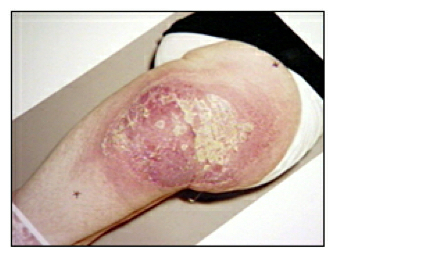
ProMED also collects, evaluates, and disseminates reports of health problems related to toxins and contamination of food and medicines. These can be quite unusual. For example, the case of the toxic leather sofas in Britain:

toxicsofaleg.jpg

Photo: Effect on leg of reaction to toxic chemical contained in sofas. From BBC.

A judge [in the UK] is expected to order several retailers to pay millions of
pounds to people who suffered burns and rashes from faulty leather
sofas….

More than 1600 people claim to have been affected by the problem. Tens
of thousands more people could have burns not yet traced to sofas.
The High Street stores, along with 11 others, may have to pay more
than 10 million pounds [USD 14.3 million] in compensation and legal
costs, the shoppers’ lawyers say. They claim that makes it “the
largest group compensation claim ever seen in British Courts.”

The sofas, which were manufactured in China, were packed with sachets
of an anti-mould chemical called dimethyl fumarate to stop them from
going moldy during storage in humid conditions.

Commonly known as DMF, the toxic, fine white powder has been used by
some manufacturers to protect leather goods like furniture and shoes
from mold. Even very small amounts can be harmful.

One sofa customer, who is well aware of the health problems caused by
her purchase, is a customer who bought a leather sofa suite from
Argos in April 2007. Almost a year later, she started to notice a
rash developing on her arms and legs. After a few weeks, her skin
started flaking off. She says the irritation was so bad, she was off
work for 2 months. This customer was seen by more than a dozen
doctors, who couldn’t work out what was causing the rash.

She said: “It was very, very painful; I couldn’t sleep at night; I
couldn’t walk about; I couldn’t drive; every time I did walk about,
the skin would fall off, and I would leave a trail of it, therefore,
I couldn’t go to work.”

Reliable histories of outbreaks/events

ProMED doesn’t just present breaking news and requests for additional reports; it frequently publishes very useful summaries of what’s been learned, and what action governmental agencies have taken. For example, “Melamine contaminated food products – Worldwide ex China” and “Prion disease Update 2009 (01)” (Mad Cow Disease and its human infectious disease, the fatal “variant Creutzfeldt-Jakob disease”.

Supporting ProMED

Believe it or not, ProMED is supported by individuals, with not a penny of funding from any government. That means they are independent (remember the movie Jaws, where the city council wants to suppress news of the shark attacks?) and fast to react. They sift a lot of news from all sorts of sources, put out calls for more information, and disseminate news in a responsible way.

If the work of this group seems like something you’d like to support, here’s your chance. They’re having a brief Spring fundraising campaign. To quote their email,

Your gift funds quick information every day – The economical, low-tech computer programs we use enable us to speed ProMED to your mailboxes, to post it online where anyone can find it, , and to provide the administrative services (accounting, office space, cell phone connections, etc.) required to support a small, agile worldwide enterprise.

ProMED-mail reaches over 50,000 public health officials, students, journalists, agricultural specialists, infectious disease professionals and others around the globe. Because it is free, subscribers in more than 187 countries have an equal opportunity to know when a disease outbreak occurs — and can spring into action when necessary to prevent or minimize its spread.

If the Spring campaign is past, here’s the main donations page.

“Sweat of the brow” copyright

As a person who enjoys the digitized reproductions, on the web, of old illustrations, I found this interesting reading:

Gutenberg: No Sweat of the Brow Copyright

From Project Gutenberg, the first producer of free electronic books (ebooks).

Work performed on a public domain item, known as sweat of the brow, does not result in a new copyright. This is the judgment of Project Gutenberg’s copyright lawyers, and is founded in a study of case law in the United States. This is founded in the notion of authorship, which is a prerequisite for a new copyright. Non-authorship activities do not create a new copyright.

Some organizations erroneously claim a new copyright when they add value to a public domain item, such as to an old printed book. But despite the difficulty of the work involved, none of these activities result in new copyright protection when performed on a public domain item:

▪ scanning and optical character recognition (OCR)

▪ proofreading and OCR error correction

▪ fixing spelling and typography, including substantial updates to spelling such as changing from American to British English

▪ adding markup (HTML, XML, TeX, etc.)

▪ digitizing, cropping, color-adjusting or other modifications to images

▪ addition of trivial new content, such as images to indicate page breaks in an HTML file, or pictures of gothic letters for the first letter in a chapter, or adding or removing a few words per chapter

▪ substantial reorganization, such as moving footnotes to end-notes, or changing the locations of pictures within the text

▪ recoding to new character sets, such as Unicode, or new formats, such as PDF

There is some value-added content that DOES get a new copyright, but only for the actual new work (that is, it may be possible to remove the new copyrighted content to go back to a public domain document):

▪ translation into another human language

▪ creating a new compilation of existing materials (though the individual items compiled retain their public domain status)

▪ creating new original art work

▪ creating an original derivative work, such as an audio performance, a new chapter, or a set of favorite quotations

▪ adding a new introduction or critical essay

Project Gutenberg is able to utilize any material which is judged to be public domain in the country of use (i.e., the United States). If it is determined that components of an item are public domain, but others are not, then the copyrighted components may be removed without the permission of whoever owns the copyright for the new content.
It is Project Gutenberg’s practice to seek permission of those who distribute materials, including copyright claimants, before harvesting their materials. This is done in order to be polite, and to allow the producer or distributor to request a particular credit be used. But if permission is not given, public domain items can still be used by Project Gutenberg, typically without any attribution. Because Project Gutenberg receives submissions from many different sources, it is not always clear where an item came from. Volunteers who submit content they did not themselves generate should be diligent about reporting sources, even if the source will not be credited in the item as distributed by Project Gutenberg.

Country roads, country people

DarkSky3.jpg

I was driving home the other night, down our rural road, in the lull between those who go right home after work in town, and those who stop at the tavern; it was moonless, very dark, and there was no traffic. Nonetheless, there are still deer who suddenly appear in the road, so I keep my speed down. Tonight I was to be reminded that there are dumber mammals on the road than deer.

I came around a long curve with a short straightaway ahead before a narrow bridge and another curve. All was darkness. Suddenly I thought I saw a tiny flash of white light––not headlights by any means, just a small quick chip of light like a shard of glass well above ground level. I began to brake and then, as my headlights lit up the straightaway, I saw people in the left lane, and something big and white completely occupying my lane and very close. More pressure on the brakes, thankful for the anti-lock brakes on our new used car, huge white wall ahead closer with people to the left of it, nowhere to go, brake harder, harder. Stop. Two feet max between me and a big old RV parked in my lane.

Three men are in the left lane with flashlights on now, though not all of them could have been on and none pointed up the road when I came around the curve. Even now they are milling about, talking, not pointing the flashlights so as to warn oncoming traffic in either direction.

One walks over to me. I put the hazard lights on, open the car door, and say angrily “You got flares?” I assumed this event, whatever it was, had just happened, no flares out yet, and I carry flares.

“Oh,” says the guy, “uh, I just picked them up, we’ve got it fixed.” Right, I believe you had flares out.

“Then why isn’t it running and showing some lights?”

“The battery was dead, we had to jump it.”

“Why isn’t it running then?”

He turns to a middle-aged woman standing passively near the motor home and tells her to start it up. She doesn’t move, so he tells her again. The other men with flashlights still are not warning traffic. A car rounds the bend behind me, sees my hazard lights, slows down quickly. It occurs to me that I may be the only functioning adult present, though all these people are over 30, and rather than driving on, I get in and back up a few feet so as not to be smashed into the RV if a chain reaction rear-end collision occurs.

The RV starts up. It has only one brake light working and the tail lights are dim. I get out and inform them of this. Throughout the entire time I am there, none of these people seems at all concerned about the danger of this situation. My car could have fishtailed in a panic stop, flailed into the other lane and taken out all three of the guys there. Two cars or trucks could have arrived at once, one around each bend, and been unable to stop safely. These people aren’t just unconcerned, they are unengaged. If they were deer they’d be long dead.

Eventually the RV sputters off, and one of the helper vehicles actually follows it, perhaps to compensate for its inadequate tail lights. I drive off too, keeping my distance, until I turn off and they continue on, perhaps to one of the two very low-end trailer parks a few miles up the road.

I’ve grown to realize, in the 12 years we’ve lived out here, that there are many folks in this area who are not only marginal economically, but mentally and empathetically as well. For them such events as this are the stuff of stories to be told over beer or while fueling the chainsaw or leaning on the fence, along with stories about arrests, fights, narrow scrapes with the law, somebody who totaled their car missing a curve. Even when injury is involved there’s no awareness of consequences or responsibility. A neighbor’s son wrecked three trucks within 2 years; two were single-car accidents but in one he rear-ended someone in town and crippled a woman. No sweat, just something that happened. Alcohol and meth were involved, but to accept that as an explanation is a cop-out. The question to be asked has to do with why, with boredom, and lack of education, and lack of parenting skills. The young man in question now has two children with a young woman from whom he is now separated (both were meth users) and our neighbor’s wife, who finally left her husband because of his irresponsibility and “anger problems” is now raising the children. She has been gathered unto Jesus, acquiring an instant pattern for life, support group, and promise that the next life will be better than this one. But it would have been much better if she had been able to leave earlier before her two sons followed their father’s pattern.

In a positive development relative to this, a representative from the women’s shelter in town (21 miles away) came to the local Food Pantry the last two weeks, doing something new: rural outreach. She’s spreading the word about their shelter and other services including a 24-hour hotline which handles not just domestic abuse calls but suicide and all other forms of distress where someone needs immediate response. The shelter folks will arrange to pick up domestic abuse victims fleeing home, as long as a safe public place can be arranged to meet. This, the hotline, and the publicity, are all very valuable for rural areas where some people are very isolated and transportation is a big issue.

Rural areas don’t exactly have different social problems from those in urban or suburban areas but the setting can really intensify them. The isolation can reduce social contact, remove options, and conceal problems from neighbors, relatives, and law enforcement. It’s legal to fire guns out here, any time. There are fewer options for kids: no neighborhood kids, no places for organized activities within walking or biking distance, schools that struggle to maintain their very existence due to enrollment that is small to begin with and fluctuates. Our area is experiencing a boom in births but a decline in kids 5-8 years old; there may not be a K-8 school closer than 20 miles by the time this year’s babies get to school.

When gas prices go up and town is 20 miles away, the impact is severe on families, school budgets (long bus runs), and the few small local stores and businesses. A couple who run a business installing gutters showed up at the food pantry during the summer; the costs of their materials had gone up so much, while construction and remodelling plummeted, that for the first time in their lives they could not feed their kids without help. We’re seeing a lot of new faces at the food pantry; they’re new to us, and new to the idea of having to ask for help.

And, when somebody parks a disabled vehicle in the road without lights or flares, they can do so in confidence that no sheriff’s deputy will happen on it and no one will see it and report it in time for the understaffed sheriff’s department to respond (no cell phone coverage for miles). It’s just there, and you deal with it. Not long ago my husband came around a sharp turn in the road (this was on the highway) to find two cars facing opposite directions stopped to chat out the driver’s side windows, completely blocking a road that is heavily used by log trucks and delivery trucks as well as by regular traffic. He was quick-witted and lucky, able to squeeze past on the shoulder. A car coming the other way could have hit him or one of the other cars and a four-car pileup would have resulted.

The stupid and careless, like the poor, are believed to be always with us. In fact some of them are “created,” when babies are malnourished, toddlers are neglected, children are uncared for and discouraged from learning and from being responsible. We can have a society with fewer poor people and fewer stupid or ignorant people, if we work at it.

Rural problems are out of sight and therefore out of mind, for most people. These areas may need extra support to keep the institutions critical to their well-being; they may need not just outreach but more decentralization of services: part-time clinics, places that offer parenting classes, bus service to job training, and so on. Some services others take for granted don’t exist here, like cell phone service, cable tv, broadband Internet access, meals on wheels. I know people who’ve had to move to town for the broadband, in order to telecommute or perform high-tech work.

With our economy nationwide staggering from the parasitism of the very rich, it is not likely that rural areas will see much of this sort of investment; indeed, most rural counties today consider themselves lucky to be maintaining minimum levels of law enforcement, road and bridge work, and health services. But what the rural parts of this country need is a national initiative, a new Tennessee Valley Project which would, for example, upgrade schools, provide clinics, and add wireless net access to benefit schools, businesses, and families. Otherwise the current population tendencies will become more pronounced: rural residents are more and more composed of these groups: retirees; those raised here who would leave if they had the education and the gumption; a smattering of “cultural creatives” from elsewhere; and those who move/stay here because they can live under the radar of law enforcement. It doesn’t have to be this way.
AppleTreeAutumn.jpg