Country roads, country people

DarkSky3.jpg

I was driving home the other night, down our rural road, in the lull between those who go right home after work in town, and those who stop at the tavern; it was moonless, very dark, and there was no traffic. Nonetheless, there are still deer who suddenly appear in the road, so I keep my speed down. Tonight I was to be reminded that there are dumber mammals on the road than deer.

I came around a long curve with a short straightaway ahead before a narrow bridge and another curve. All was darkness. Suddenly I thought I saw a tiny flash of white light––not headlights by any means, just a small quick chip of light like a shard of glass well above ground level. I began to brake and then, as my headlights lit up the straightaway, I saw people in the left lane, and something big and white completely occupying my lane and very close. More pressure on the brakes, thankful for the anti-lock brakes on our new used car, huge white wall ahead closer with people to the left of it, nowhere to go, brake harder, harder. Stop. Two feet max between me and a big old RV parked in my lane.

Three men are in the left lane with flashlights on now, though not all of them could have been on and none pointed up the road when I came around the curve. Even now they are milling about, talking, not pointing the flashlights so as to warn oncoming traffic in either direction.

One walks over to me. I put the hazard lights on, open the car door, and say angrily “You got flares?” I assumed this event, whatever it was, had just happened, no flares out yet, and I carry flares.

“Oh,” says the guy, “uh, I just picked them up, we’ve got it fixed.” Right, I believe you had flares out.

“Then why isn’t it running and showing some lights?”

“The battery was dead, we had to jump it.”

“Why isn’t it running then?”

He turns to a middle-aged woman standing passively near the motor home and tells her to start it up. She doesn’t move, so he tells her again. The other men with flashlights still are not warning traffic. A car rounds the bend behind me, sees my hazard lights, slows down quickly. It occurs to me that I may be the only functioning adult present, though all these people are over 30, and rather than driving on, I get in and back up a few feet so as not to be smashed into the RV if a chain reaction rear-end collision occurs.

The RV starts up. It has only one brake light working and the tail lights are dim. I get out and inform them of this. Throughout the entire time I am there, none of these people seems at all concerned about the danger of this situation. My car could have fishtailed in a panic stop, flailed into the other lane and taken out all three of the guys there. Two cars or trucks could have arrived at once, one around each bend, and been unable to stop safely. These people aren’t just unconcerned, they are unengaged. If they were deer they’d be long dead.

Eventually the RV sputters off, and one of the helper vehicles actually follows it, perhaps to compensate for its inadequate tail lights. I drive off too, keeping my distance, until I turn off and they continue on, perhaps to one of the two very low-end trailer parks a few miles up the road.

I’ve grown to realize, in the 12 years we’ve lived out here, that there are many folks in this area who are not only marginal economically, but mentally and empathetically as well. For them such events as this are the stuff of stories to be told over beer or while fueling the chainsaw or leaning on the fence, along with stories about arrests, fights, narrow scrapes with the law, somebody who totaled their car missing a curve. Even when injury is involved there’s no awareness of consequences or responsibility. A neighbor’s son wrecked three trucks within 2 years; two were single-car accidents but in one he rear-ended someone in town and crippled a woman. No sweat, just something that happened. Alcohol and meth were involved, but to accept that as an explanation is a cop-out. The question to be asked has to do with why, with boredom, and lack of education, and lack of parenting skills. The young man in question now has two children with a young woman from whom he is now separated (both were meth users) and our neighbor’s wife, who finally left her husband because of his irresponsibility and “anger problems” is now raising the children. She has been gathered unto Jesus, acquiring an instant pattern for life, support group, and promise that the next life will be better than this one. But it would have been much better if she had been able to leave earlier before her two sons followed their father’s pattern.

In a positive development relative to this, a representative from the women’s shelter in town (21 miles away) came to the local Food Pantry the last two weeks, doing something new: rural outreach. She’s spreading the word about their shelter and other services including a 24-hour hotline which handles not just domestic abuse calls but suicide and all other forms of distress where someone needs immediate response. The shelter folks will arrange to pick up domestic abuse victims fleeing home, as long as a safe public place can be arranged to meet. This, the hotline, and the publicity, are all very valuable for rural areas where some people are very isolated and transportation is a big issue.

Rural areas don’t exactly have different social problems from those in urban or suburban areas but the setting can really intensify them. The isolation can reduce social contact, remove options, and conceal problems from neighbors, relatives, and law enforcement. It’s legal to fire guns out here, any time. There are fewer options for kids: no neighborhood kids, no places for organized activities within walking or biking distance, schools that struggle to maintain their very existence due to enrollment that is small to begin with and fluctuates. Our area is experiencing a boom in births but a decline in kids 5-8 years old; there may not be a K-8 school closer than 20 miles by the time this year’s babies get to school.

When gas prices go up and town is 20 miles away, the impact is severe on families, school budgets (long bus runs), and the few small local stores and businesses. A couple who run a business installing gutters showed up at the food pantry during the summer; the costs of their materials had gone up so much, while construction and remodelling plummeted, that for the first time in their lives they could not feed their kids without help. We’re seeing a lot of new faces at the food pantry; they’re new to us, and new to the idea of having to ask for help.

And, when somebody parks a disabled vehicle in the road without lights or flares, they can do so in confidence that no sheriff’s deputy will happen on it and no one will see it and report it in time for the understaffed sheriff’s department to respond (no cell phone coverage for miles). It’s just there, and you deal with it. Not long ago my husband came around a sharp turn in the road (this was on the highway) to find two cars facing opposite directions stopped to chat out the driver’s side windows, completely blocking a road that is heavily used by log trucks and delivery trucks as well as by regular traffic. He was quick-witted and lucky, able to squeeze past on the shoulder. A car coming the other way could have hit him or one of the other cars and a four-car pileup would have resulted.

The stupid and careless, like the poor, are believed to be always with us. In fact some of them are “created,” when babies are malnourished, toddlers are neglected, children are uncared for and discouraged from learning and from being responsible. We can have a society with fewer poor people and fewer stupid or ignorant people, if we work at it.

Rural problems are out of sight and therefore out of mind, for most people. These areas may need extra support to keep the institutions critical to their well-being; they may need not just outreach but more decentralization of services: part-time clinics, places that offer parenting classes, bus service to job training, and so on. Some services others take for granted don’t exist here, like cell phone service, cable tv, broadband Internet access, meals on wheels. I know people who’ve had to move to town for the broadband, in order to telecommute or perform high-tech work.

With our economy nationwide staggering from the parasitism of the very rich, it is not likely that rural areas will see much of this sort of investment; indeed, most rural counties today consider themselves lucky to be maintaining minimum levels of law enforcement, road and bridge work, and health services. But what the rural parts of this country need is a national initiative, a new Tennessee Valley Project which would, for example, upgrade schools, provide clinics, and add wireless net access to benefit schools, businesses, and families. Otherwise the current population tendencies will become more pronounced: rural residents are more and more composed of these groups: retirees; those raised here who would leave if they had the education and the gumption; a smattering of “cultural creatives” from elsewhere; and those who move/stay here because they can live under the radar of law enforcement. It doesn’t have to be this way.

AppleTreeAutumn.jpg

Zombies make things better

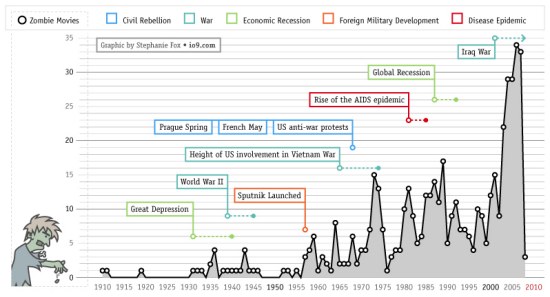
From Information Design Watch comes a link to a graph showing that the number of zombie movies in the US parallels war and social upheavals.

Makes as much sense as anything. Now a media talking head can look at it and conclude that since spikes in zombie movies precede peace or betterment of social upheaval, the zombie movies must be the curative force. “After this, therefore because of this” (post hoc ergo propter hoc) is the only logic the mass media seem to use.

zombies3chart.jpg

This is much reduced; take a look at the original where you will also find a long list of the movies they used for the chart, going back to a 1910 version of Frankenstein.

The site of the zombie movie graph, 1o9 Strung out on science fiction, labels it with the category “Chart Porn”. I took this term to be some sort of a spin-off from Edward Tufte’s “chartjunk” (= irrelevant, distorting, or distracting material added to charts) but a search on the term told me that it may mean something different. Another blog that deals with charts, themessthatgreenspanmade, tells us

In case you were wondering, the reason this post is titled “chart porn” (a term shamelessly stolen from Barry Ritholtz at The Big Picture) is that if you open the charts with a Windows Internet Explorer browser using Windows Vista, you get multiple windows opening on a somewhat random basis (at least, that’s what happened to me).

It reminded me of six or eight years ago when a co-worker would come by and say, “Type in http://www.whitehouse.com” and up would come some porn site that proceeded to open more and more windows faster than you could close them … and then the boss would walk by.

I took a look at chart porn on The Big Picture, where indeed the term is used frequently, but couldn’t decide exactly what it meant. Most of the chart porn posted there, from major media, is what one could call “tarted up”, that is for sure. Looks like a good site for skeptical commentary on current economic authorities and their continually readjusted b.s.

Recent Zombie Appearance in Real Life

zombies2.jpg

These members of an event called “SF Zombie Mob 2007” got a little confused and evidently tried sucking brains out of iMacs––no gratitude, don’t they remember how Apple freed them in the 1984 Mac commercial? Meanwhile the Apple Store employees jostled for position to take the best photos; other stores had no sense of humor and shut the zombies out, according to the source.

Why we need universal health care, among other things

It’s the day before Thanksgiving, and soon one of our most shameful national events will begin in newspapers around the country.

What could this be? Our local paper calls it “Season of Sharing”, and it also goes by holiday-themed names such as “Lighting a Candle”, “Giving Tree” and so on. The newspapers identify local residents in dire need, with the help of social agencies and non-profits, and feature their stories as a way of soliciting help from readers.

During the holidays people are, or wish to be seen as, more generous: this is the season of food drives for food banks (which scramble for food every month of the year), the time when families descend on social service events to volunteer and feel good or show caring behavior to their children while dishing up holiday meals to people who only eat this well once or twice a year. I don’t need to point out the blind spots here. My point is different.

Let me describe one of the most egregious examples I have seen of the “Season of Sharing” phenomenon. A few years ago our paper featured a young man in his early twenties who had lost a leg to leukemia at age 11 or so. He was still using the artificial leg fitted to him a decade or more earlier. He worked full time, spending a good deal of each day on his feet; the ill-fitting prosthesis was painful and did not work well but he had no alternative. He had no medical insurance at his job and did not make enough to save up for a new leg (several thousand dollars, perhaps, including fitting). His mother also worked but her medical insurance of course did not cover him any more and had not been adequate to such a need when he was a minor, either. This young man was suggested by some agency as a person who could not be helped by the existing social welfare system.

Why was this young man having to depend on the kindness of strangers for a chance to get a prosthetic leg that fits so he can work and walk without so much pain? Is this the best way for our nation to respond to such needs?

The Rush Limbaughs of the world denounce universal health care as coddling of citizens who should take care of themselves and could if they’d just work harder. English statutes of long ago differentiated between the helpless––old and sick, babies and children–and the “sturdy beggar”, someone who could work if he would. Assistance to the former was available though limited and begrudged (read Oliver Twist); the latter group, also called vagrants and rogues, were considered to be undeserving criminals. We’ve maintained this distinction and pretended that there is living-wage employment for everyone who wishes to work, and that healthy families can be maintained by anyone who tries hard enough. At the same time we rely on unemployment, illegal immigration, union-busting, and foreign guest-workers (in skilled occupations) to keep wages low and employees compliant. (The foreign guest-workers not only work cheaper but fill jobs that our educational system allegedly can’t prepare people for.)

This condemnation and denial of care can be attacked on many grounds, including our definition of what is right, moral, compassionate. William Blake wrote that “A dog starved at his master’s gate, Predicts the ruin of the state”.

But let us only examine it coldly from the standpoint of the best interests of society, regardless of morality. Not to belabor the point, in our current social and economic environment a country can no longer ghettoize poor people so that they quietly starve, or prey primarily upon one another. And from the ranks of the poor and working poor (who cannot afford health insurance, who are one car breakdown away from unemployment, who do not get time off to care for a sick child) come young people whom we need to fill jobs, pay taxes, solve future problems, and care for us when we are old.

The child who cannot pay attention in school because of untreated illnesses such as chronic ear infections, or because of hunger, or because his or her family moves every other month or lives in a car or at a campsite, or in an uninspected rental with no heat, mold on the walls, and open sewage in the backyard: what are the odds that this child will receive a good education, go on to work, stay out of trouble with the law, not become a teen mother or absent father, and in short become what we like to call “a productive member of society”? And who suffers, besides that person and his or her family? Does Rush Limbaugh really think that our country is not damaged in a strictly material sense?

In a truly efficient and rational capitalist state (no, I am not a socialist or communist, not even a community organizer) perhaps we could simply round up the non-productive of whatever age, elderly or teens or doomed toddlers (and parents of same), and exterminate them. (In the movie Soylent Green, they were even turned into food for the rest of the populace.) At least then we would be aboveboard about what we were doing. Our current course reminds me of when I used to live in the agricultural area near Sacramento and people would dump unwanted pets and boxes of kittens on our roads because “farmers always have room for another dog, or a few barn cats”. Guess who got to drive away feeling okay, and who had to cope with the sad task dealing with dying kittens, feral dogs chasing sheep, and so on? The top strata of society have gated communities, apartment buildings with doormen, cars with locked doors, to insulate them from the suffering and crime. The rest of us have to wear blinders and harden our hearts if we wish not to see and feel the suffering; we cannot wall ourselves off from the crime and violence. Our country as a whole is made worse in many ways, which affect us all.

Of course, a contribution to the most pitiful “Season of Sharing” case is supposed to make us feel that we have done our part, and that there is a safety net for the truly deserving.

The fallacy of this self-serving pretense will become harder to deny as the economy grows worse and people at nearly all levels are affected with job loss, retirement fund evaporation, inability to afford health care or college, and so on. Those who felt that only those who “deserved it” were suffering, will have to figure out why the suffering is now their own as well.

Some claim to believe that private charities will take care of the old, the disabled, the helpless. But upon examination they mean only those who are old/disabled/helpless––and poor. For themselves and their relatives, they will find other better solutions, they will demand the best. And they overlook the patchwork undependable nature of voluntary social work, the potential for bias (racial, religious, ethnic, etc.) in providing services, and the fact that, like the Season of Sharing, it makes beggars of the needy. They will be helped if enough individuals are generous or guilty, if churches choose to run soup kitchens or tutoring programs in their locale, not because they are our fellow citizens and we have a collective duty to them.

Government social agencies are far from perfect. But they are responsible to all of us, they are directed to serve all citizens without bias, they can be improved when we demand it. Whether we are moved by morality, self-interest, or concern for our country’s future, the choice is clear: establish universal health care and make it work. If you disagree, try explaining your position to the young man who needed a new leg.

Children’s books online: social history, public-domain illustrations

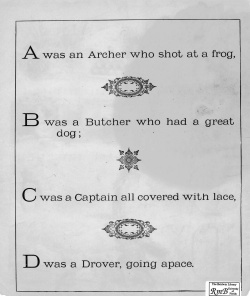
PicturePuzzleABCtb.jpg

PicturePuzzleABC2tb.jpg

I’m fascinated by the wealth of vintage illustrations that have been scanned and made available on the web. The BibliOdyssey blog is all about this and a great place to browse. Lately I’ve been doing some ferreting about for myself too, and of course have to share my discoveries.

This time it’s old children’s books in two collections at the University of Florida: the Literature for Children Collection at the University of Florida Library (2455 titles), and the Baldwin Library of Historical Children’s Literature (4787 titles). Cruise the title lists (LCC, Baldwin) and find multiple versions of Robinson Crusoe, Aesop’s Fables, and other classics; various illustrated ABC’s, Annie and the elves, and other stories published in 1852 by the American Sunday-School Union, Around the World with Santa Claus (1891), At war with Pontiac, or, The totem of the bear : a tale of redcoat and redskin (1896)–––and we’re still in the “A” section. [Above are the first two pages from Aunt Louisa’s picture puzzle alphabet (1880).]

Below are a few illustrations from volumes in these collections, and I was assured when I enquired that “Nearly all of the books in this collection [LCC] are public domain. Those that are not are clearly labeled as such. You can use the images freely, although we always appreciate a statement attribution that they came from Literature for Children (palmm.fcla.edu/juv/).” I think the books from the Baldwin Collection would be public domain as well.

These are presented here considerably reduced in size and resolution, compared to the online originals, which are each over 1 MB when saved as pdfs.

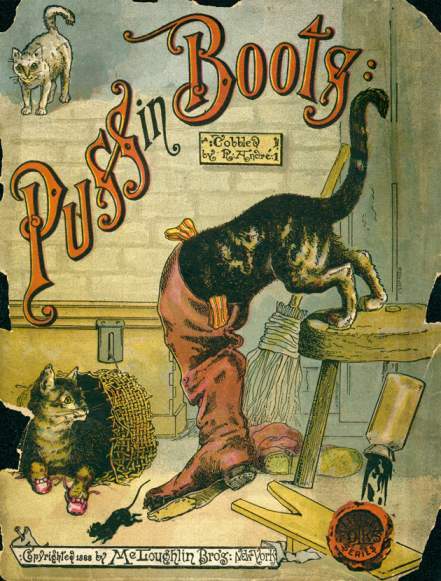
PussInBoots.jpg

Above, the cover from Puss in Boots (c. 1888), illustrations by André, R ( Richard ), 1834-1907 [nom de plume of English artist William Roger Snow].

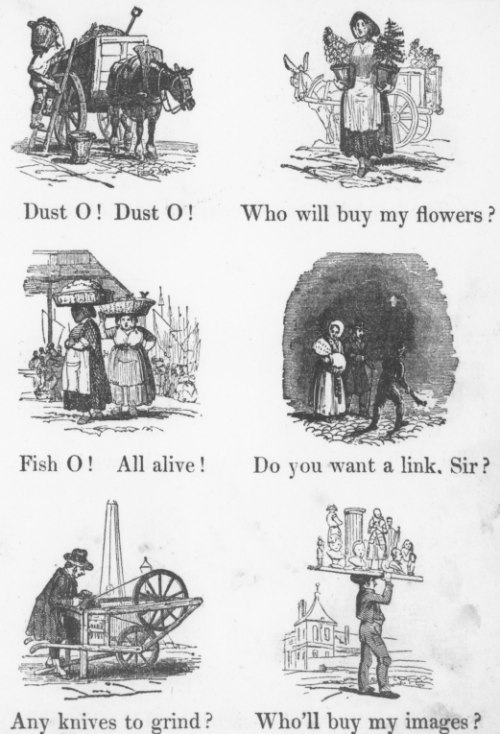
Below, the “London Cries” page from Aunt Mary’s primer: adorned with a hundred and twenty pretty pictures (1851) shows some of the street pedlars of the city along with their characteristic “cries” to hawk their wares, which gave us phrases such as “Cockles and mussels, alive alive-o!” Also shown are the dustman collecting who knows what (horse manure?) and a “link-boy,” selling his services to light the way of those travelling the unlit streets before gas lighting.

LondonCries1.jpg

Below, the cover and two pages from A museum of wonders and what the young folks saw there explained in many pictures (1884), text and illustrations by Frederick Burr Opper [Baldwin Library Digital Collection, also at the University of Florida].

MuseumOfWonders1.jpg
MuseumOfWonders2.jpg
MuseumOfWonders3.jpg

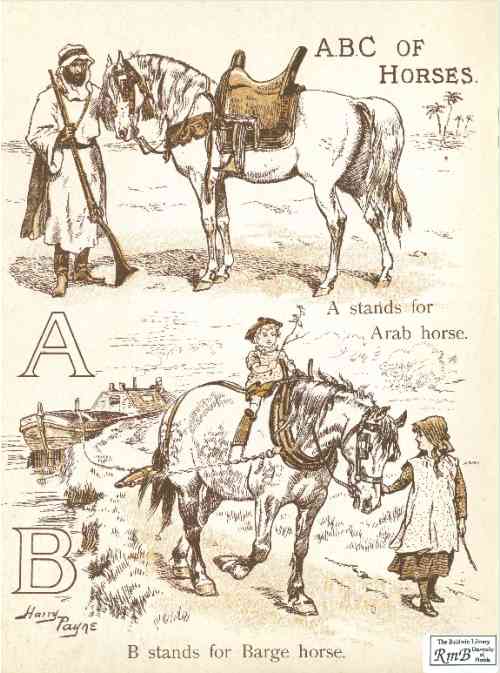
Below, the cover and two illustrations from the ABC of Horses (1880)

ABCHorsesCover.jpg
ABCHorses1.jpg
ABCHorses3.jpg

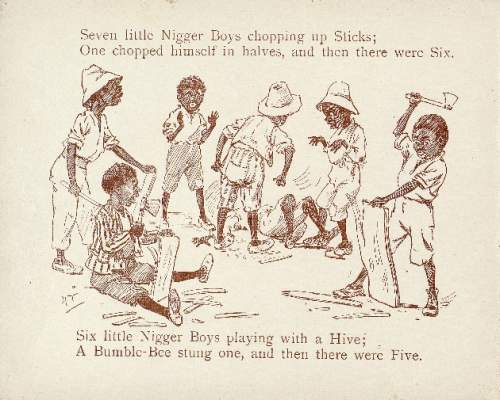
But there’s more here than quaintness, nostalgia, or public-domain illustrations. Children’s books are always in some way a part of society’s revelation of itself to children, and its effort to shape their attitudes. The very first entry in the alphabetical list of titles is 10 little nigger boys (1890), no author given. A rhyme recounts how a group of ten young black boys gradually becomes only one, as various accidents befall them on their journey. One oversleeps (the most benign incident); one chokes, one is hugged to death by a bear at the zoo, one “cuts himself in half”, you get the idea.

NiggerBoys1.jpg

This reminded me of the familiar title Ten Little Indians (Agatha Christie) and I wondered what the connexion was. Wikipedia was the first entry in a Google search and was very informative.

It is Christie’s best-selling novel with 100 million sales to date, making it the world’s best-selling mystery…The novel takes place on an island off the coast of Devon in late 1930s named Indian Island. Eight people of different social classes journey to the Soldier Island mansion are invited there by a Mr. and Mrs. U.N. Owen but the eight people don’t know them. Upon arriving, they are told by the butler and his wife, Thomas and Ethel Rogers, that their hosts are currently away. Each guest finds in his or her room a slightly odd bit of bric-a-brac and a framed copy of the nursery rhyme “Ten Little Soldier Boys” (“Ten Little Niggers” in the original 1939 UK publication and “Ten Little Indians” in the 1940 US publication) hanging on the wall:

Ten little Soldier boys went out to dine;
One choked his little self and then there were nine.
Nine little Soldier boys sat up very late;
One overslept himself and then there were eight.
Eight little Soldier boys traveling in Devon;
One said he’d stay there and then there were seven.
Seven little Soldier boys chopping up sticks;
One chopped himself in halves and then there were six.
Six little Soldier boys playing with a hive;
A bumblebee stung one and then there were five.
Five little Soldier boys going in for law;
One got into Chancery and then there were four.
Four little Soldier boys going out to sea;
A red herring swallowed one and then there were three.
Three little Soldier boys walking in the zoo;
A big bear hugged one and then there were two.
Two Little Soldier boys sitting in the sun;
One got frizzled up and then there was one.
One little Soldier boy left all alone;
He went out and hanged himself and then there were none.

Christie10Little.jpg

Cover of the first UK edition of this book (from Wikipedia).

Thus we learn, among other things, that in England in 1939 it was acceptable for Agatha Christie to publish her mystery novel under the title Ten Little Niggers in England, but not in the US, the title was changed to And Then There Were None. The book has been filmed a number of times under this latter title, and also as “Ten Little Indians.”

I wonder what black children were reading in 1890, when 10 little nigger boys was published. Books for children were a luxury, whether in white households or black. Was there a parallel endeavor to publish reading material for black kids? Maybe I’ll email the people at the University of Florida again and see what they can tell me.