Feminism from the ground up, resoled

(A follow-up to my post of Sept. 29.)

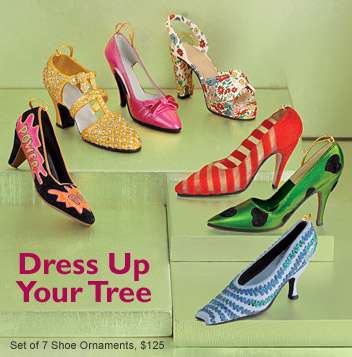
No kidding, I’m on the Metropolitan Museum mailing list and this is their latest to me:

ZZ32303A06.jpg

7 miniature women’s shoes for Christmas tree ornaments, a mere $125. As before, I direct your attention to the shape of the shoe compared to the natural (I called it “roughly square-ended”) shape of the human foot.

Women are brainwashed into wearing shoes that cripple them and won’t allow them to walk––think Chinese foot-binding––and this footwear is glorified as religious ornamentation and signs of high status. We are offered, in both high and everyday fashion, clothing that restricts movement (at least we’re temporarily without the corsets that caused, really did cause, the fainting so common to that era), and makeup that escalates into clownishness, and oh the hell with it why go on.

A short comment on the economic bailout

So many bloggers and talking heads comment on big political issues that I have steered clear of them; believe me, I rant a-plenty in our living room! But in my lifetime only two other distinct events have stood out, at the time of occurrence, as of such great importance for the future. The first was the assassination of John F. Kennedy; the second was 9-11 (though most of the disaster that has followed it has been chosen and created by the Bush administration). And this is the third.

I’ll keep my comment short. Here’s the email I just sent to Nancy Pelosi.

Dear Madam Speaker,

My husband and I, lifelong Democrats, commend you for your courage and good judgment in standing against the bailout bill. I also heard your interview last Thursday on NPR and was well impressed with your arguments and articulate presentation. I wish we could vote for you.

But be assured that many out here agree with your position. I do not know if you share my belief, that our economic structure is not just tilted drastically in favor of big interests–everyone knows that–but is unsound at its core, based on speculation and unending growth that cannot continue. Hence a series of bubbles that burst. The citizen always gets hurt whether by mortgage foreclosures that can devastate a family for decades, or by inflation, paying for bailouts, increasing the national debt, and so on. The war may be a distraction, as one of its purposes, from all this.

There is no “free market” when the biggest players set the rules and then are bailed out when they break them. At this point in history a free market is neither desirable nor possible. Let’s start changing it to a market that benefits the majority of people (not just by providing low-wage jobs) and benefits the planet and our succeeding generations.

Respectfully,

[me]

rural southern Oregon

Little Blue Books

LittleBlueBooks2.jpg

Before Project Gutenberg, there were Little Blue Books. Before paperback books (not pamphlets, but books) came along in the 30’s, there were Little Blue Books. My remaining library of them is shown above, and below are a few with a paperback of the same period.

LittleBlueBooks1a.jpg

“Little Blue Books” was the popular name for a series of tiny publications printed on pulp paper, with slightly heavier paper covers, by E. Haldeman-Julius between 1919 and 1951. Emanuel Julius was the son of Russian immigrant Jews; he said his life was changed when, as a boy, he got hold of a 10 cent publication of Oscar Wilde’s grim poem The Ballad of Reading Gaol, and read it straight through oblivious to the freezing weather in which he sat. At that moment, he thought “how wonderful it would be if thousands of such booklets could be made available.”

All of us who were bookworms in childhood can identify with that experience. I don’t remember much of my youth but I can still recall exactly where I was when I read the end of To Kill A Mockingbird: sitting on a log in some neighbor’s front yard, having put the paperback in my pocket before setting out ostensibly to take the dog for a walk. And on a difficult bus trip to San Francisco, I buried myself in the Little Blue Book of Macbeth and came across the encouraging lines “Time and the hour/run through the roughest day.” I was on the bus with my parents, but seated separately; they were barely speaking to one another, having had another of the fights over my father’s extreme stay-at-home habits–this one followed by “Well, maybe you’d like to go to San Francisco (about 40 miles)?” “Driving and parking there is too awful.” and so on, until we ended up a silent trio on Greyhound.

I still have that 15-cent copy of Macbeth, and most of the other LBB’s that I acquired. The titles in this line included a lot of classics, not just because they were copyright-free, but because Haldemann-Julius had an agenda: a mixture of the classical, the progressive, and the useful.

Here’s a sampling of titles [my apologies for such a long list, but, I confess, when I started looking at the lists on the Penn State Axe Library site, I found it hard to stop selecting examples!] :

1a. The Ballad of Reading Jail, by Oscar Wilde. First Edition. [Cover title.] People’s Pocket Series. [1919] [

1b. Rubaiyat of Omar Khayyam. Second Edition. [Cover title.] People’s Pocket Series. [1919]

3a. Walt Whitman’s Poems. [1920.]

17c. On Walking, by Henry David Thoreau. [1921.]

60a. Emerson’s Essays. [1920.]

90c. The Mikado, by W. S. Gilbert.

94a. Trial and Death of Socrates. [1920.]

95a. Confessions of an Opium Eater, by Thomas De Quincey. [1920.]

60a. Emerson’s Essays. [1920.]

140a. America’s Prison Hell, by Kate O’Hare. [1920.

1001. Tales of Italian Bandits [by] Washington Irving. [1927.]

1002. A Dictionary of Sea Terms [by] Frank Wells. [1926.]

1003. How to Think Logically [by] Leo Markun. [1926.]

1004. How to Save Money [by] J. George Frederick. [1926.]

1005. How to Enjoy the Orchestra [by] Isaac Goldberg. [1926.]

1006. A Book of Children’s Games [by] Grace Perkins. [1926.]

1008. The Origin of Religion [by] Joseph McCabe. [1926.]

1009. Typewriting Self Taught [by] Miriam Allen DeFord. [1926.]

1010. A Handbook for Amateur Magicians [by] George Milburn. [1926.]

1011. Pocket Dictionary, English-French, French-English [by] Vance Randolph. [1927.]

1014. The Best American Jokes, edited by Clement Wood. [1926.]

1017. Without Benefit of Clergy [by] Rudyard Kipling. [1926.]

1019. Bluebeard and His Eight Wives [by] Clement Wood. [1926.]

1020. Why I Am an Infidel [by] Luther Burbank. [1926.]

1021. Italian Self Taught [by] Isaac Goldberg. [1926.]

1022. An Odyssey of the North [by] Jack London. [1926.]

1162. Mystery Tales of Ghosts and Villains [by] Montague Rhodes James, Katherine Rickford [and] Charles Dickens.

1163. The Policewoman’s Love-Hungry Daughter and Other Stories of Chicago Life [by] Ben Hecht.

1177. Woman and the New Race [by] Havelock Ellis.

1178. The Chorus Girl and Her Lover’s Wife and Other Stories [by] Anton Chekhov.

1179. How to Make Desserts, Pies and Pastries [by] Mrs. Temple.

1182. How to Make Your Own Cosmetics [by] Gloria Goddard.

1183. How to Play Checkers [by] W. Patterson.

1185. The Weather: What Makes It and Why [by] Clifton L. Ray.

1186. A Handbook of the Rules of Golf, compiled by Harold Dix.

1188. Sex and the Garden of Eden Myth, a Collection of Essays on Christianity [by] Maynard.

1189. Pin Money: One Hundred Ways to Make Money at Home [by] Gloria Goddard.

1190. What Price Love? [by] Anton Chekhov.

1286. Do Human Beings Have Free Will? A Debate: Affirmative: Professor George Burman Foster, Negative: Clarence Darrow.

There are some patterns here: how-to and self-improvement, progressive politics and “free-thinking” about religion and society, and, of course, plenty of titles containing the words “love,” “sweetheart,” and “sex.” But there are also the large and small lights of Western Literature: Shakespeare, Goethe, Tolstoy, O. Henry, Poe, Hawthorne, Melville, Balzac, Ibsen, Mark Twain, Rabelais…there seems no end to Haldeman’s inclusiveness, until one thinks that a complete set of Little Blue Books would make the ideal accompaniment to a desert island existence. And cheap, too; in the beginning they retailed for a nickel; by the early 1960’s the price was all the way up to fifteen cents. So the 39 titles above would have run you a total of $1.95 at a nickel apiece, $5.85 at 15 cents.

Haldeman published some works he’d written himself, including

1287. Brann, Who Cracked Dull Heads [by] E. Haldeman-Julius.

1288. America’s Fakirs and Guides, Surveying the Leaders and Misleaders of Our Day [by] E. Haldeman-Julius.

The Brann of LBB 1287 was William Cowper Brann (1855-1898), an opinionated American journalist and newspaper owner who attacked aspects of religion, social pretense, and anything else that roused his ire. He died in Waco, Texas, after being shot in the back by a man who objected to his vituperative editorials about Baylor College; Brann turned and shot his attacker dead before walking to the jail, from which he was soon released. He died the next day.

I encountered Haldeman’s magnum-opus-in-small-pieces early in my teens. I was questioning religion and social conventions, fascinated with adventure tales, and lived with my nose in a book. Mostly I went to the library, but Little Blue Books were portable, full of surprises and oddities, and felt in some way personal. I must have bought them by mail, because I never remember seeing one in a bookstore or on a drugstore book rack. I now know that J. Edgar Hoover had mounted a campaign against Haldeman and his publications in the 1950’s and forced most bookstores to stop carrying them. The Little Blue Book series was, in its day, “edgy”: marked by progressive politics, including socialism, and consideration of forbidden topics like free love, homosexuality, evolution, birth control, and women’s rights. You can see that a cranky repressive guy like Hoover couldn’t allow such pollution of the American intellectual landscape.

Despite J. Edgar, 300 million Little Blue Books were published between 1919 and 1978, so I suppose those who blame our moral decline on things like Pokémon and gay marriage can just add Haldeman’s smart-alecky elitist smut to their list.


LittleBlueBooks3.jpg

July 4 edition

On July 4 in the US we celebrate the adoption of the Declaration of Independence by the Continental Congress in 1776; we should also celebrate December 15, 1791 when the Bill of Rights came into effect after being ratified by three-quarters of the states.

Two events reported this week got me thinking about civil liberties.

Court orders Google to release information to identify all YouTube viewers

Viacom has been suing Google, owner of Youtube, alleging that Youtube has acted “as a willing accomplice to Internet users who put clips of Viacom’s copyrighted television programs on the popular video-sharing website.” Google tried to resist Viacom’s “request for data on which YouTube users watch which videos on the website in order to support its case in a billion-dollar copyright lawsuit against Google.” Google maintained that “the data should not be disclosed because of the users’ privacy concerns,” citing the (Video Privacy Protection Act) VPPA, 18 U.S.C. § 2710 but US District Court Judge Louis Stanton, San Francisco, found in favor of Viacom and ordered Google to release to Viacom “all data from the Logging database concerning each time a YouTube video has been viewed on the YouTube website or through embedding on a third-party website.”

How many people does this affect? In January 2008, nearly 79 million users used YouTube, making over 3 billion video views. Over 80 million videos are hosted on YouTube, uploaded by users. Not bad for a business founded in 2005, which Google says makes a “negligible” profit. (from Wikipedia.)

Handing over the identifying information on 79 million distinct users is a huge breach of privacy, and unjustifiable given that a study of videos removed from YouTube at the request of copyright holders found that only 2% of them were from Viacom.

Google was apparently hoist by its own petard, having previously claimed in a blog post, titled “Are IP addresses personal?”, that “We . . . are strong supporters of the idea that data protection laws should apply to any data that could identify you. The reality is though that in most cases, an IP address without additional information cannot.” The judge evidently reasoned that this made release of the data acceptable despite restrictions of various federal legislation concerning electronic privacy. Many of the comments posted in response to this post disagree. It seems that people using home computers, as opposed to mobile laptops, are particularly likely to be identifiable.

Will this ruling begin another round of lawsuits against individuals, like those filed by the Recording Industry Association of America over music downloads? Seems very possible.

But of more concern is the breach of the principle of the Video Privacy Protection Act of 1988. The VPPA

was passed in reaction to the disclosure of Supreme Court nominee Robert Bork’s video rental records in a newspaper. The Act is not often invoked, but stands as one of the strongest protections of consumer privacy against a specific form of data collection. Generally, it prevents disclosure of personally identifiable rental records of “prerecorded video cassette tapes or similar audio visual material.” [see information at EPIC, the Electronic Privacy Information Center]

The Patriot Act, of course, trumps everything, from the Bill of Rights to the VPPA, but legally it can be considered (and I hope that day comes soon) as ad hoc legislation to meet a temporary need, or perceived need; as something to be retired after the need, or the panic, or the madness, has subsided. When privacy legislation––not passed in response to a specific political crisis––is bypassed or invalidated, that loss may be permanent.

But it’s worse in Britain

Britain may have pushed things along, in the civil liberties, field, with the Magna Carta in 1215, but they never got around to anything like a Bill of Rights. So citizens there have much less legal basis to protest violation of their rights by a government bent on reforming behavior and cracking down on terrorism.

Habeas corpus?

The British government recently extended the period for which it could hold terrorism suspects, without charges, to 42 days. In a recent public debate, the new law was criticized on pragmatic grounds: “The problem with 42 days is we keep innocent people for longer than we do guilty ones,” said House of Commons member David Davis, because those with clear evidence against them were charged first. That, he said, did nothing to encourage “moderate Muslims” to help counterterrorism operations. Davis is resigning his MP position in order to force an election for the seat; he will run (or “stand,” as they say there) and he promises to make threats to civil liberties a central issue of the election.

Watching everyone

Britain has gone into video surveillance in a big way; the BBC presented the finding of a report, that in 2006 there were “are up to 4.2m CCTV cameras in Britain – about one for every 14 people.” The BBC cited another report issued about the same time, from the human rights group Privacy International, which found that “figures suggest Britain is the worst Western democracy at protecting individual privacy.” The two worst countries in the 36-nation survey are Malaysia and China, and Britain is down there with them in the bottom five because of “endemic surveillance”. Must be pretty safe there, you’d think. Wrong. Some liberals in the London city government used their Freedom of Information Act to get crime statistics: London has 10,000 closed-circuit TV cameras for crime fighting––costing 2 million pounds––but 80% of crime goes unsolved, and districts with more cameras don’t do better than those with fewer.

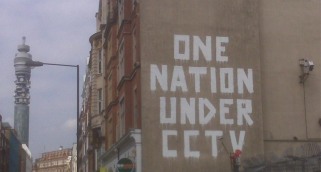
Recently their CCTV cameras became even more Robocop-like:

Britain is already one of the most watched nations on earth and now “talking” CCTV cameras are to be installed in 20 areas across the country. Britain is believed to have 20 per cent of the world’s CCTV cameras already. The loudspeakers will allow CCTV operators to bark orders at people committing anti-social behaviour.

cctv.jpg

Photo from Global Security Challenge. (I assume the painter is covering up this anti-social graffiti, or maybe he is the graffiti-ist himself, caught on camera.).

The neighbors are complaining about you…Off you go, then.

Since 1999 the British government has made use of Anti-social Behaviour Orders or ASBOs to control a wide range of behaviors

Anti-social behaviour has a wide legal definition – to paraphrase the Crime and Disorder Act 1998, it is behaviour which causes or is likely to cause harassment, alarm or distress to one or more people who are not in the same household as the perpetrator. Among the forms it can take are:

graffiti – which can on its own make even the tidiest urban spaces look squalid

abusive and intimidating language, too often directed at minorities

excessive noise, particularly late at night

fouling the street with litter

drunken behaviour in the streets, and the mess it creates

dealing drugs, with all the problems to which it gives rise. [from a Home Office page]

ASBOs are civil, not criminal actions against an individual and thus the individual doesn’t have the procedural safeguards––being charged, evidence being produced, and so on––that go along with criminal actions. What is the impact of an ASBO?

They stop people from doing stated things or going to stated places. They last for a minimum of two years, but can last longer. Those given ASBOs can be ‘named and shamed’ in local media, and sometimes are. Orders have been granted for abusive behaviour, vandalism, flyposting, and harassment as well as more the more celebrated exotic problems such as elderly people incessantly playing gramophones. Whilst ASBOs are civil orders, criminal penalties can result from breaching them.

Students can be barred from attending school, individuals can be banned from a certain area, or required to agree to a contract banning certain behaviors such as graffiti, rowdiness, drunkenness, or being too noisy. Violation of the contract can have criminal penalties, even though the justification for the ASBO itself was never tested or proved.

And how is this “Criminalisation of Nuisance,” as one author titled his book on ASBOs, working? Once again, not too well, it seems. “Hooliganism” is still common, and in 2006 a year-long study in England and Wales found that half the Asbos were broken, and “some teenagers saw them as glamorous….an Asbo was now viewed as a “diploma” that boosted a child’s street credibility. “Some of the friends are left out now because they are not on an Asbo,” said the mother of three young men who were all on Asbos.” Moreover, the report was published on the same day that “a separate study by the Institute for Public Policy Research suggest[ed] Britain’s youth are among the most badly behaved in Europe.”

So, if all this tough action by the British government is just as effective as requiring American travelers in airports to take off their shoes, and randomly surrender their laptops for two weeks…what purpose is being served? Ah, I wouldn’t care to say, could be hazardous to my liberty. Here’s to the Bill of Rights, and a citizenry wise and bold enough to defend it.

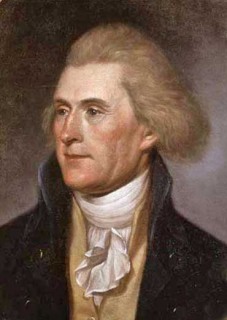
Photos from Breakthroughgen.org.

BenjFranklin.jpg ThomJefferson.jpg