FDR speaks to us from 1936, and it still applies

President Franklin Delano Roosevelt reflects on the “enemies of peace” with which he struggled in his first term:

“We had to struggle with the old enemies of peace—business and financial monopoly, speculation, reckless banking, class antagonism, sectionalism, war profiteering.


”They had begun to consider the Government of the United States as a mere appendage to their own affairs. We know now that Government by organized money is just as dangerous as Government by organized mob.”

Speech at Madison Square Garden (October 31, 1936)

Franklin_Delano_Roosevelt,1941.jpg

Roosevelt in 1941, signing the Lend Lease Act. Photo source.

Advertising, banks, and Salome of the Seven Veils

We all have our own “If I ruled the world, this is how I’d fix it” fantasies. They don’t need to be reasonable, or part of a comprehensive strategy, so they’re self-indulgent and fun. I’d ban advertising as one of my first moves, or at least restrict it to words only: no pictures, no music or jingles, just cortex stuff. Miles per gallon, nutritional content, ease of installation, peppermint flavor. Well, the advertiser could wax poetic about how his product would transform your love life, turn commuting into a Le Mans experience, and make sadness and boredom as extinct as the dodo, but if the pitch is just in words printed in black and white, how many of our fellow citizens these days would bother to read it? And if they did, how convincing would it be?

Here’s an example of what vexes me about ads:

Ads and Banks.jpg

I photographed this ad in one of those gargantuan one-stop-shopping stores which also has a house bank. In fact, their bank used to be Washington Mutual, distinguished for being “the United States’ largest savings and loan association until it became the largest bank failure in U.S. history.” [Wikipedia]

As I recall, it was a WaMu ad way back in the early 90’s that told me all was not well with the American banking industry: it showed a car racing through one of those cones-in-a-line tests of driving skill, and posting a smoking-hot speed by the simple expedient of running over most of the cones. The voice-over and text said, “We break the rules for you”. Gives you a glow of confidence, like the surgeon rushing into your operating room bloody to the elbow, saying, “I didn’t bother washing up after that bowel resection, more important to get here in a hurry for your case!” It seemed obvious to me that this was not a good philosophy for a bank. But what did I know, since it actually worked great for all the big banks, until suddenly the bottom fell out. Who could have known? Then we bailed them out, so no harm done.

Take another look at the ad. Its ostensible purpose is to encourage us to put our money in savings accounts. Seriously? How likely is that? With savings interest rates running between 1.14% and 1.44%, and annual inflation at 2.63% (or more, if you are a living person rather than a statistical construct), we’ll all be rushing to get that deal. “Lose money while you save”, what a terrific idea. No, the real intent here is to convince us rubes that the bank is a serious trustworthy institution that cares about our welfare. The face of the woman is carefully chosen to be seductive yet serious. We don’t need the financial system reform bills that the administration has asked for, we can just rely upon the banks to do the right thing. The House bill barely passed back in December, on a party-line 223-to-202 vote, and the Senate is still trying to figure out how to get it past the Republicans.

Nor should we resent the past and present behavior of the banks and investment companies. Don’t be bothered that

The nation’s six largest banks — all committed to this balls-out, I drink your milkshake! strategy of flagrantly gorging themselves as America goes hungry — set aside a whopping $140 billion for executive compensation last year, a sum only slightly less than the $164 billion they paid themselves in the pre-crash year of 2007.

Those are the words of Matt Taibbi, who has done his homework, and reports in Rolling Stone on just how the big money guys managed to: make tons of money through dishonest dealing; leave us all holding the bag of devalued real estate, foreclosures, and lost jobs; get bailed out by our tax money; and then start the same process over again, generating new excessive profits from unsound and possibly illegal investment practices. Taibbi systematically details the various con games utilized by the financial institutions.

Maybe counter-ads are the answer. I could create ads instead of longing to ban them.

BanksTrust1.jpg

[painting by Laura Givens, entitled ‘Wild Abandon’]

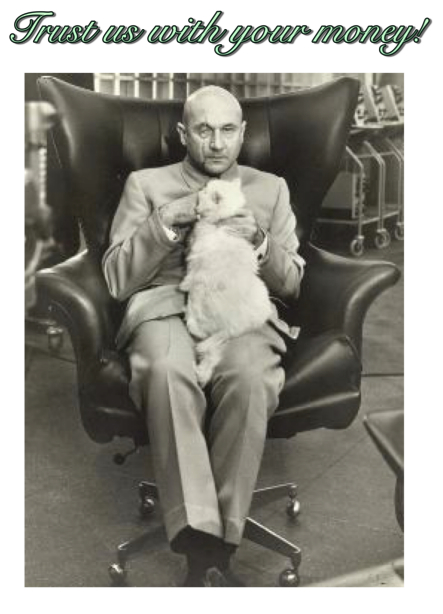
Or, for consumers who like authority figures,

BanksBlofed1.jpg

[if you’re not up on old James Bond villains, that’s Donald Pleasance as Ernst Blofeld, SPECTRE leader who has sensibly turned international banker after the Cold War ended]

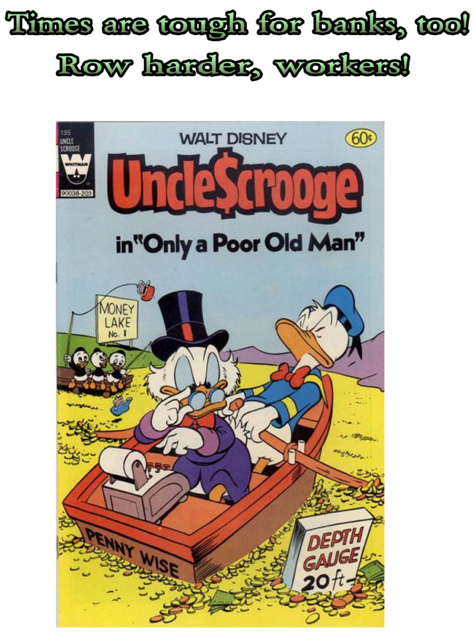
Or this,

BanksScrooge.jpg

On a more positive note, remember that there is an alternative to doing business with Scrooge, Blofeld, and Salome of the Seven Veils. Visit your local credit union. Ours offers overdraft protection (no $35 fees), various kinds of accounts, loans, and debit cards. Credit unions used to restrict membership to certain groups (teachers, employees of a certain company or industry, etc.) but now many exist to serve all the residents of a certain area. Executives don’t get million-dollar bonuses, and the emphasis is on local service and steady management.

A credit union is a cooperative financial institution that is owned and controlled by its members, and operated for the purpose of promoting thrift, providing credit at reasonable rates, and providing other financial services to its members. Many credit unions exist to further community development or sustainable international development on a local level… Credit unions are “not-for-profit” because they operate to serve their members rather than to maximize profits. [Wikipedia]

Find a credit union in your area in the phone book, or use this directory.

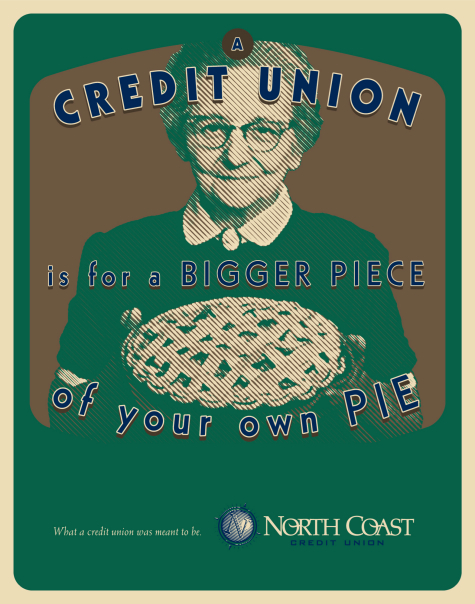
Even credit unions have to advertise. But I won’t quibble with this ad.

BankCreditUnionAd.jpg

Changing the American Health Care system

I responded to an email from moveon.org today, which wanted me to sign a petition to my Senators and Representative stating:

Full petition text:
“I strongly believe that Americans should have the choice of a public health insurance option operating alongside private plans. This will give them a better range of choices, make the health care market more competitive, and keep insurance companies honest.”

My convictions on this matter are different from moveon.org’s and from the position that Congressional Democrats like Baucus are putting forth, and so in the area for appending comments to be sent, I said:

Actually, this petition misrepresents my beliefs on this issue, based on 63 years of observation.

The single payer option is what we must adopt. A separate “public health insurance option “ will burden the taxpayer with the most expensive patients while the private plans take the profitable healthy younger patients. We have let this happen with FedEx and the Postal System, and private charter schools and public schools. The tax-supported option ends up with the mandate of accepting the part of the market that is least profitable.

We all know that the health care mega-corporations and industry groups will promise *anything* now, like a person being waterboarded. Five years from now will they be so devoted to the health of every American? No chance. And once this process is over, we are stuck with it—there will not be the political will to make substantial changes for another generation or more.

Mind you, I don’t think there’s much chance of a single-payer option coming to pass. American politics runs on money, and who’s got more of it than the “medical-industrial complex”? Americans have more passion and energy to invest in American Idol than in their own health and survival.

What the US now spends on health care

Here are some interesting figures, from the National Coalition on Health Care, a non-profit coalition bringing together “large and small businesses, the nation’s largest labor, consumer, religious and primary care provider groups, and the largest health and pension funds”, with 2 former presidents as Honorary Co-Chairs, Bush the first and Jimmy Carter. So their figures are likely to be well-researched and certainly not wildly radical.

National Health Care Spending

In 2008, health care spending in the United States reached $2.4 trillion, and was projected to reach $3.1 trillion in 2012.1 Health care spending is projected to reach $4.3 trillion by 2016.1
Health care spending is 4.3 times the amount spent on national defense.3

In 2008, the United States will spend 17 percent of its gross domestic product (GDP) on health care. It is projected that the percentage will reach 20 percent by 2017.1

Although nearly 46 million Americans are uninsured, the United States spends more on health care than other industrialized nations, and those countries provide health insurance to all their citizens.3

Health care spending accounted for 10.9 percent of the GDP in Switzerland, 10.7 percent in Germany, 9.7 percent in Canada and 9.5 percent in France, according to the Organization for Economic Cooperation and Development.4

footnotes refer to these sources:

1 – Keehan, S. et al. “Health Spending Projections Through 2017, Health Affairs Web Exclusive W146: 21 February 2008.

2 – The Henry J. Kaiser Family Foundation. Employee Health Benefits: 2008 Annual Survey. September 2008.

3 – California Health Care Foundation. Health Care Costs 101 — 2005. 02 March 2005.

4 – Pear, R., “U.S. Health Care Spending Reaches All-Time High: 15% of GDP.” The New York Times, 9 January 2004, 3.

More about credit cards, debt, pyramids, and eschatology

My recent post “Why I’m canceling my Bank of America credit card” brought a comment pointing out that cancelling credit cards can adversely affect one’s credit score, perhaps making it difficult to borrow for cars and houses. That may well be true, but it seems to spring from a view of credit and debt quite different from mine. Rather than dump this on the hapless commenter as a reply, I’ll say it here.

First, the companies have no incentive to restrict credit, and I expect they’ll soon be back to sending out credit apps to dogs and kindergartners. When the banks lose money through extending credit unwisely, they raise rates on the rest of us to recoup. Worst case, as now, the taxpayers bail them out, they buy each other up, write off debt, get tax breaks for losses. So I think people can safely cancel all but one or two cards, and still be able to use credit to make major purchases.

Second, I’m hoping that ordinary people, who DO have an incentive to learn from the present debacle, may start restricting their debt to large necessary items. Cars and houses usually do require going into debt. But I’m old enough to remember life without credit cards; my mom had a metal “charge-a-plate” for Macy’s, and there was layaway at some stores, but no credit cards. If you wanted something you saved up for it. If you couldn’t afford to go out to dinner, you didn’t go. To those accustomed to incurring chronic credit-card debt for indulgences, such a life may seem a bleak prospect. But actually I recall very few people growing despondent for want of cruises, concert tickets, and designer handbags.

Back in the 1980’s when I saw items at an Oregon department-type store bearing tags that said “Want me? Buy me!” and a credit card logo, I viewed it as a dangerous & selfish attitude to cultivate. Along with it came the re-definition of human beings as “consumers”.

The present economic system is a pyramid scheme because it is predicated on continual growth. We do not live in a world of infinite resources and space, therefore neither population nor consumption/production can continue to increase forever. Business interests, and even the administration, expect increased consumption to get us out of this depression. If it does, it can be only a temporary fix.

I know there are a lot of optimists out there who say not to worry about dismal stuff like the economy, climate change, and all that, because the world is going to end in 2012 (Mayan Calendar theory) or “soon” (some Christian fundamentalist theories). But I just can’t be that optimistic. Call me crazy, but what if we’ve got those Mayan numbers just a little bit wrong? Or some translator introduced an inaccuracy into the Book of Revelations? What if God has changed His mind, and now thinks it might be amusing to see how His little creatures manage with these challenges? We just can’t know. Better to keep our eyes on the ball, as it were (in this case the planet & its inhabitants) and not count on the Umpire calling the game on account of End of Time.