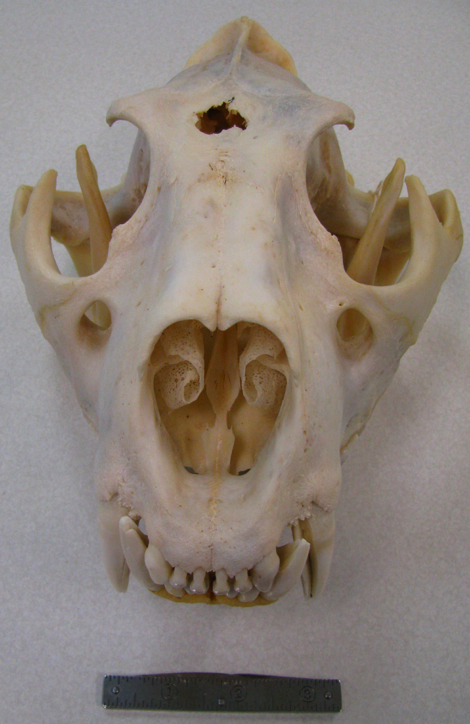
Recently I had the opportunity to photograph a lion’s skull. Since there seem to be few detailed photos of this subject online, I’m posting several here.
The ruler at the bottom is 3.5 inches (89mm) long. I don’t know the age or sex of this animal, only that it was an African lion. The ragged hole on top of the skull is a bullet hole; more about that later.
The large openings flanking the nasal cavity, and beneath the huge eye-sockets, puzzled me. Turns out they are the passageways into the eye area for the infraorbital nerve, artery, and vein (technically, each of these two openings is termed the “infraorbital foramen”). The infraorbital foramen is indicated by the arrow in the anatomical illustration below, from the University of Wisconsin’s digital collection of Veterinary Anatomical lllustrations.
In searching out what these openings were, I came across the information that Asiatic lions often have divided infraorbital foramina, with a bony bridge across the opening. Most African lions have the single open foramen seen in the skull I photographed. It is believed that the modern lion originated in Africa, and some researchers think that a severe population bottleneck at some point in the recent past of Asiatic lions may have allowed this variation to become common.
[]Thanks to Bibliodyssey for the post on these great illustrations.
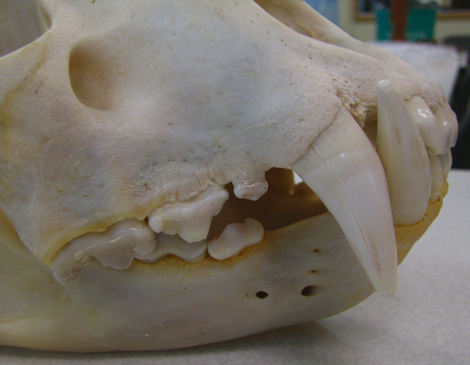
The longitudinal grooves or clefts in the upper canines seem odd, though I found similar ones on another skull pictured online. Most of the lion skull images online were casts, replicas, and lack these grooves.
On the side of the lower mandible, insertion openings for nerves or blood vessels are clearly visible.
Turbinate bones and the air we breathe
Few skulls or replicas online show something I was especially interested in, the delicate turbinate bones within the nasal cavity. These are thin bony structures, with a rich blood supply, found in all modern warm-blooded animals. Here they show a complex scrolled shape that is marvelous to see.
The turbinates are also seen in the first photo; the close-up above is taken from a lower vantage point, looking farther into the nasal cavity.
What is the function of these unusual structures? The tissue covering the turbinate bones warms, cleans, and humidifies air as it is inhaled; the air exhaled from the lungs, which has picked up even more heat and moisture there, is cooled to reclaim moisture and prevent dehydration. The turbinate system also benefits the sense of smell. Humidifying the incoming air is necessary to “preserve the delicate olfactory epithelium needed to keep the olfactory receptors healthy and alert” (Wikipedia); the turbinates also increase the surface area of the inside of the nose and direct air upward toward the olfactory receptors. And, in humans at least, the tissues are what get swollen and obstruct our breathing, when we have allergic reactions.
The dinosaur connexion
The turbinates interested me because I remember reading speculation, in Digging Dinosaurs by palaeontologist Jack Horner, that dinosaurs were endothermic, warm-blooded––and he based this partly on indications that some skulls showed signs of turbinate bones (I don’t recall what exactly he described). However, that book was published in 1988, and it appears that subsequent researchers have failed to substantiate his suggestion. The delicate turbinate bones rarely survive as part of fossilized skulls; for example, none have been found in fossils of ancient birds’ skulls, even though the birds must have been warm-blooded. Some dinosaurs have thin tubular nasal spaces, as do present-day reptiles, and it is argued that those with narrow nasal cavities couldn’t have had turbinate bones. The question is not settled, but the current consensus seems to be that dinosaurs were not warm-blooded. For point-by-point summaries of the controversy, these seem good: The Evidence for Ectothermy in Dinosaurs (cold-blooded) and The Evidence for Endothermy in Dinosaurs (warm-blooded). Wikipedia considers some additional points in Physiology of dinosaurs.
Cause of death of this lion
The lion skull had been lent for a display in our local library, by the US Fish and Wildlife Service Forensics Laboratory in Ashland Oregon. It’s the only lab in the world devoted to crimes against wildlife, and I’ll say more about it in another post. The skull had been evidence in a despicable case: an individual bought up lions (they breed easily in captivity) from roadside zoos, put them in small enclosures and sold the right to shoot them. My grim theory is that the “hunters” were required not to shoot at the head, so that more shots could be taken at the living lion, before the highest-paying customer delivered the coup de grace in a shot to the top of the head. First, that would yield the most money for the scumbag, and second, it would have been very difficult to make this shot to the top of the head of a lion still standing.
At least the person running this was tried, and convicted with the assistance of the Wildlife Lab. Highly unlikely that he received a sentence I’d regard as sufficient, though.
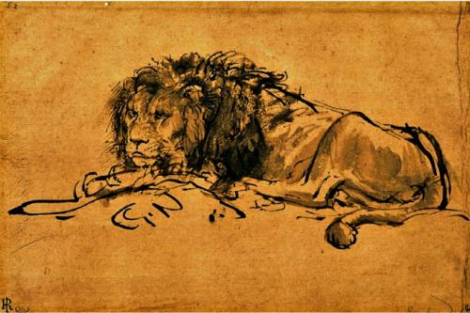
A Cape Lion (Panthera leo melanochaitus, now extinct) in a drawing of the Dutch artist Rembrandt Harmenszoon van Rijn. Circa 1650-52. Location: Louvre, Paris. Source, Wikimedia Commons.












 nosleepingdogs

