The County Fair

DropZoneRide.jpg

We went to our county fair today, and were saddened at how it is shrinking. Even counting time spent eating elephant ears and bento, we were there less than three hours. Everything seems smaller in numbers of exhibits, and generally drained of vitality. It takes a lot of people, many of them unpaid, to put together an event like a fair; and the aspects of human life that a fair represents are not very important to our culture any more. This is the list that comes to my mind, describing a fair: agriculture, livestock, tradition, handcraft, businesses, history, hobbies, the future … community.

Fairs used to be places where the particular identity of the county (or state) was visibly celebrated by exhibiting the products of its soil and water, the activities of its local industries, the skills of its residents, the promise of its youth. Fairgoers left feeling pretty good about where they lived. Kids perhaps saw some future for themselves in the county, whether it was the possibility of a job, an interest in a local college, or a general feeling that “this place has a future and I may be part of it”.

Our county, Jackson County (Oregon) only has a population of 200,000; 75,000 live in the largest town, Medford. Even before the 2008 crash the county’s economy was not in good shape. Construction of new houses (sometimes built “on spec”) was strong, fueled in part by arrival of new residents who had sold homes in California for inflated prices. Institutionally and individually, the county is still struggling to adjust from the demise of the timber industry, yet cannot get it together to protect from development its 8500 acres of orchard land which has historically produced high-value crops for export. Unemployment is above 12% , compared to the rate for the state as a whole, which is 10.5%. Both rates are steady, not improving.

Given all that, maybe the lackluster fair is just an accurate representation of where the county is. Still, if there was a agriculture pavilion, we never found it. If there was a county-sponsored exhibit meant to retain residents and attract new business, we never saw that either.

I did snap some photos, just of things that interested me.

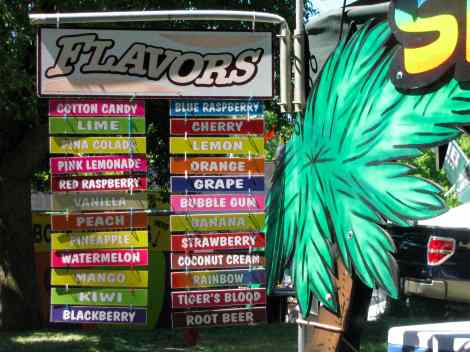
FlavorsAtTheFair.jpg

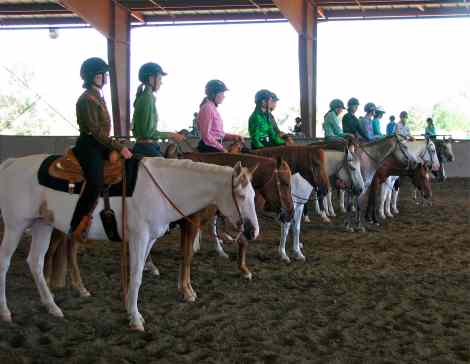
YoungEquestrians.jpg

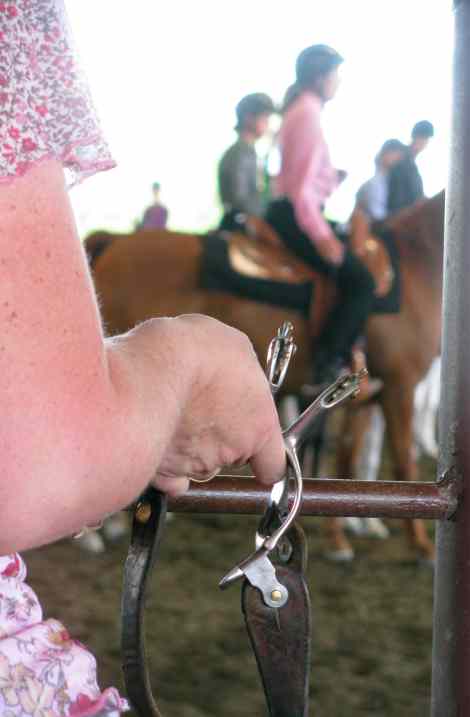
Spurs&YoungRiders.jpg

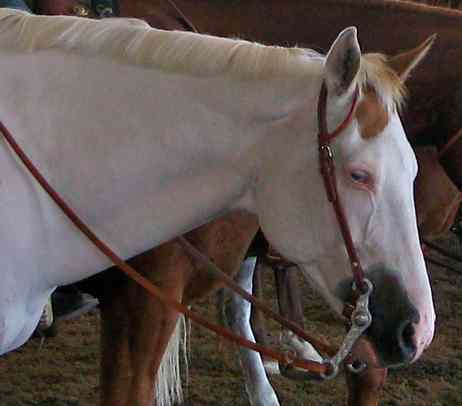
Blue-eyedHorse.jpg

BoyInT-Shirt.jpg

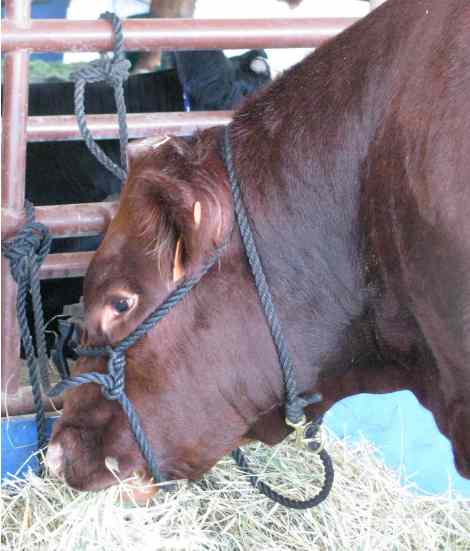
BeefyCow.jpg

BoysWithGuns.jpg

BoysInTheAir.jpg

GirlsInBoots.jpg

EmbroideredGriffon.jpg

Embroidered Griffon, in the Needlework section.

Horse.jpg

GirlWithT-Shirt.jpg

MarineHummer.jpg

HorseMane.jpg

Man-Dog-Frisbee.jpg

RideShaft.jpg

Siskiyou wildflowers we found today

We walked along a dirt road above the Applegate River. Warm and dusty, with the cool green river below. On the far side of the river there are houses, and tied up below one was a gas-powered dredge for sucking up sand and silt from the bottom or edges of the river, in search of gold. Any gold around here is powder or very small pieces; nothing you would think of as a nugget is likely to be found. Since the moratorium on dredging in the rivers of California more dredgers are mucking up our rivers.
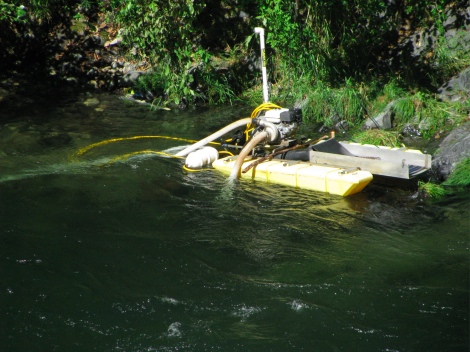
dredge on the river.jpg

The first wildflower we saw was the rather spectacular Blazing Star (Mentzelia laevicaulis).

Mentzelia laevicaulis, Blazing star1.jpg

This plant likes dry gravelly roadcuts such as this one, and is found from British Columbia south through much of the West. Accounts say the flower is fragrant but we didn’t notice that.

The buds are a pale dawn yellow. Or the color dawns should be.
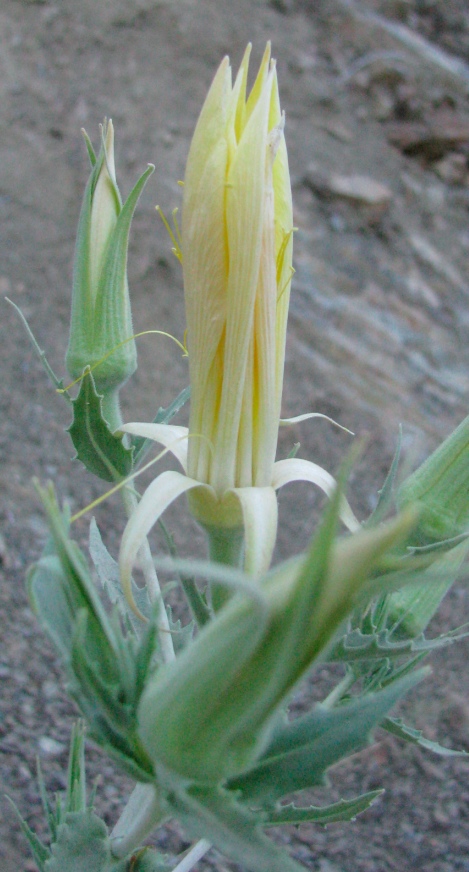
Mentzelia laevicaulis, Blazing star, flower buds.jpg

The leaves are distinctive: hairy and scalloped.
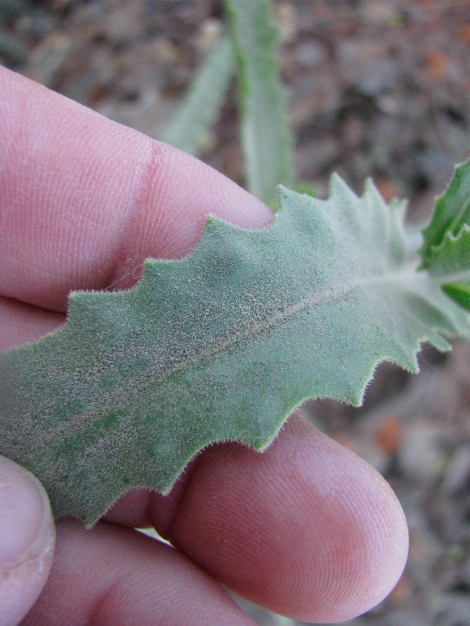
Mentzelia laevicaulis, Blazing star leaf close-up.jpg

Mentzelia was named by Linnaeus in honour of Christian Mentzel (1622-1701), a German physician, botanist and lexicographer. The epithet laevicaulis (laevi = smooth + caulis = stalk) refers to the comparatively smooth stems of this species in comparison to other Mentzelia species.” For this information on etymology, often impossible to find, I am indebted to the University of British Columbia’s Botany Photo of the Day site.

The flower is somewhat similar to one we saw back in mid-June, Yellow or Western Salsify (Tragopogon dubius), below. But Yellow Salsify is introduced, not native, and regarded as invasive in many areas. The root is “edible raw (slightly bitter, celery-like taste with a hint of cucumber) and cooked (smells like parsnips). The plant exudes a milky latex when cut.” Another species, T. porrifolius, has been known since Roman times for its edible roots and young shoots, and even cultivated. Europeans who introduced T. porrifolius to North America too, where it’s considered an “agricultural weed”, not quite as bad as “invasive”.
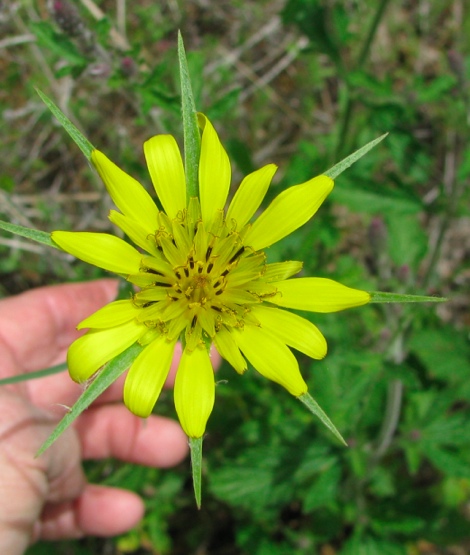
Tragopogon dubius  -Yellow Salsify,Western Salsify -flower.jpg

The Yellow Salsify leaf is narrow, not scalloped, and smooth rather than hairy.

Tragopogon dubius  -Yellow Salsify,Western Salsify - leaves.jpg

Large patches of Rabbit-Foot Clover (Trifolium arvense) lined the road. This is another European introduction.
Rabbit-Foot Clover.jpg

We were too late to see any with fresh blooms, so here they are from A Photo Flora of the Devon and Cornwall Peninsula.

Rabbit-foot clover, Trifolium arvense.jpg

Among the patches of Rabbit-foot Clover there were many spiderweb constructions like this one, a foot wide or more,

Spiderweb, flat with tunnel 1.jpg

consisting of layers of horizontal web and a funnel at the back where the spider awaits. While we did not see the spiders, the webs are said to be characteristic of species in the genus Agelenopsis, which are called Grass Spiders or Funnel Weavers. They’ve recently been found to be venomous, with a toxin that affects substances involved in muscle movement in insects and in mammals, though humans would seem to have little to worry about unless walking barelegged through the webs and stirring up the spiders. However, the toxins might have medicinal potential (anti-seizure medication). There are good photos of the spiders here along with information at bugguide.net.

Here are the yellow blooms of what we are sure is some species of Eriogonum, which includes plants often known by some variation of the common name “Wild Buckwheat” (although they have nothing to do with the crop plant that provides buckwheat flour).

Eriogonum spp..jpg

The flowers were borne on leafless thick reddish stems.

Eriogonum spp. base of leafless bush.jpg

We tried to figure out which Eriogonum this was, but were having no success. Finally we came across this remark about another unidentified Buckwheat,

This plant has frustrated me for years — it is so very common here but I’ve yet to find a picture or a description in any of my layman’s field manuals. However, my favorite A Field Guide to the Plants of Arizona by Anne Orth Epple, did have this to say: almost all species of eriogonum are difficult to identify, even for the expert botanist. For the amateur, simply recognizing wild buckwheat as such is an accomplishment. So there! Epple says that there are 53 species of eriogonum in Arizona.

Okay, we’ll rest on our laurels of having tagged it as a Buckwheat! The author above goes on to say of her plant, “As the season wears on, the flowers gradually turn a brilliant rust color”, and that seems to be true of ours as well, perhaps another Eriogonum characteristic.
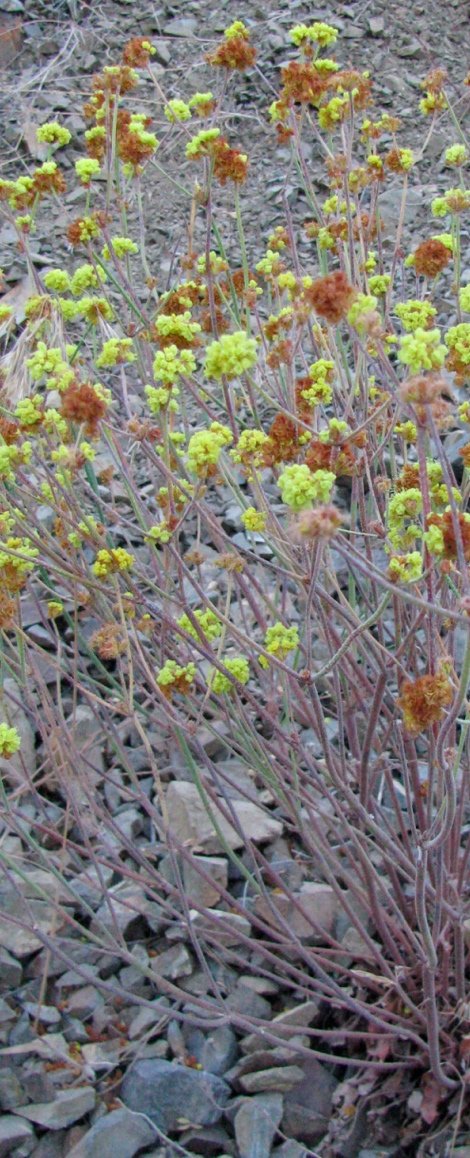
Eriogonum spp. bush.jpg

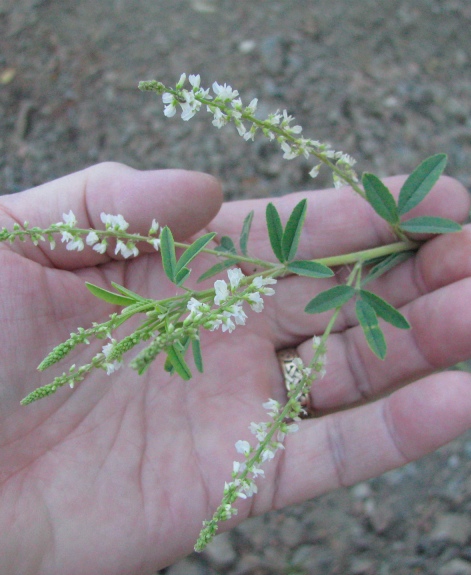
One final plant turned out to be another clover.
White sweet clover, Melilotus albus .jpg

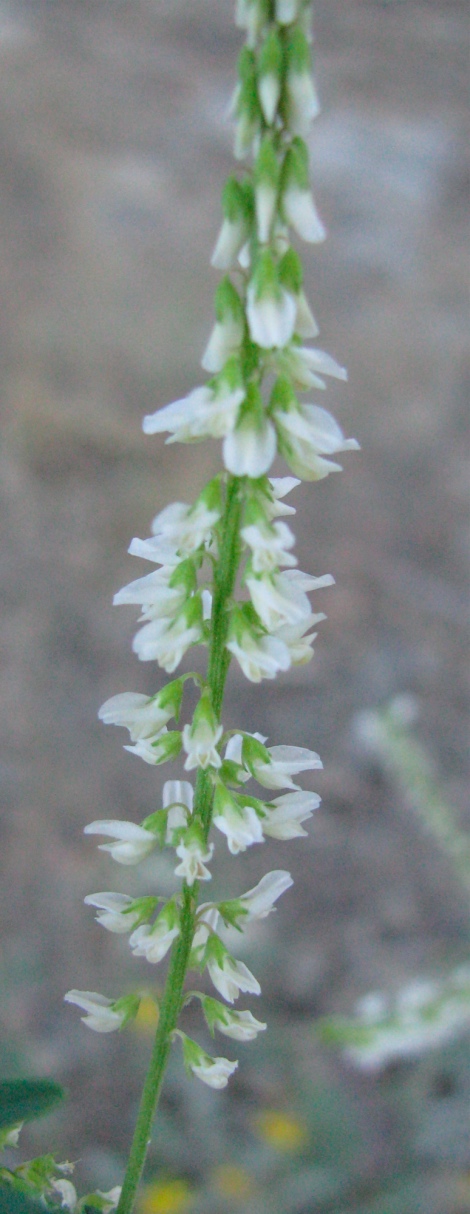
This is White Sweet Clover (Melilotus albus).
White sweet clover, Melilotus albus -closeup.jpg

Pretty and delicate looking, but another European introduction, for cattle forage, which has turned out to be invasive.

And by then Jack the mastiff thought it was time to call it quits, even though he’d been down to the river for a drink.

Jack thirsty, tongue lolling.jpg

He drank from his water dish back at the car, and then supervised while we drove home.

We brake for butterflies

Butterflies everywhere in the air! so many you have to drive about 5 miles an hour, letting the current of your progress gently push them out of the way. That’s how it was one morning last week, on the paved forest road where we often walk. By 3 pm it would be 100°. Though there were still wildflowers in bloom, these butterflies seemed not to be feeding, but mostly just flying and chasing one another. Breeding season? One did land for a moment on Dan’s finger and another swooped at it aggressively, over and over.

California Sister butterfly,one flying at another.jpg

California Sister butterflies (Adelpha bredowii), ventral view.

As before, in a different location on this road, we saw scores of the California Sister butterfly (Adelpha bredowii) but this time none of the Lorquin’s admiral (Limenitis lorquinii) seen then. Swallowtails were present too, like sunlight in flight, but in small numbers. Unlike the others, the swallowtails never lighted for long either on vegetation or on the road, where the California Sisters clustered to get minerals from visible animal scat or from remains too small for us to see.

California sister.jpg

California Sister butterfly, dorsal view, on the road.

California sisters butterflies landing on road.jpg

Ant pulling butterfly.jpg

This ant was pulling along the body of a California Sister butterfly. It would move the butterfly an inch or two, then stop and scurry around looking (I thought) for a more effective place to grab on.

Swallowtail butterflies

The swallowtails never let us get close enough for a really good look or photo, and we may even have seen more than one species. Dan, whose eyes are better, says that most were a pale yellow. the others brighter. Of the three found in our area, one is a species called the Pale Swallowtail (Papilio eurymedon) that uses Ceanothus spp. for its larval host plant, and Blueblossom ceanothus (Ceanothus thyrsiflorus) is a common flowering shrub here. Very pretty too, growing to 6 feet or more in height and flowering in varying shades of blue and lilac. Most are past their peak of bloom now, beginning to fade or entirely withered; these photos are from June.

canothus.jpg

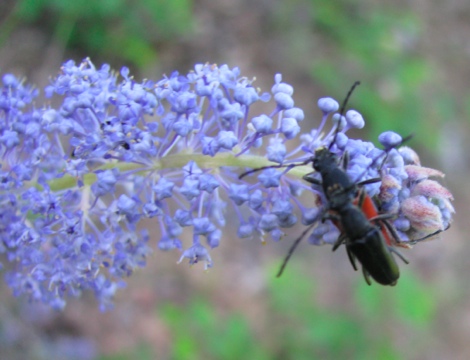
Ceanothus thyrsiflorus & mating beetles.jpg

The British biologist J. S. B. Haldane was engaged in discussion with an eminent theologian. ‘What inference,’ asked the latter, ‘might one draw about the nature of God from a study of his works?’ Haldane replied: ‘An inordinate fondness for beetles.’ Indeed, of the 1.5 million described species on the planet, 350,000 are beetles, more species than in the entire plant kingdom. So I didn’t even try to identify the mating beetles in the photo above, but Dan picked up Insects of the Pacific Northwest (by Haggard and Haggard) and found them easily: Anastrangalia laetifica, the Dimorphic Long-horned Beetle! The female’s red wingcovers are visible on the right side, beneath the male’s all-black back.

This is the Pale Swallowtail, below. [Photo by Franco Folini, from flickr]

papilio eurymedon2.jpg

Different life stages of the Pale Swallowtail caterpillar are shown here, and for the Anise Swallowtail here. Caterpillars can have quite different appearances, as they pass through successive moults (stages called instars), and so the one illustrated in your field guide for a given species may not look at all like the one you find.

The other Swallowtails likely to be seen here in Southwestern Oregon are the Anise Swallowtail (Papilio zelicaon) and the Western Tiger Swallowtail (P. rutulus). Oregon’s state insect is the Oregon Swallowtail (P. oregonius, sometimes called P. bairdii) but it’s found in the dry sagebrush canyons of Eastern Oregon and Washington along with its caterpillar host plant Tarragon or Dragon’s-wort (Artemisia dracunculus). Our culinary tarragons are varieties of this same species.

Ways in which print is superior to digital, part 1

NOTE: Which are better, fish or birds? Silly question, right? We must ask, “better for what?” I’m not maintaining that print is inherently a “better” medium than digital media, nor the reverse. Each has its strengths and weaknesses. We should maintain both.

1. Permanence

Information on the web can vanish overnight. Maybe your webhost suddenly shuts down.

I once hosted a site that talked more about this idea at http://mind.blazingfast.net/TheRaft, but it seems that google nor the wayback machine are able to help me reclaim that page. source

blazingfast.jpg

Or someone controlling the content decides on a change…

Last week, President-elect Barack Obama launched a Web site with detailed information about his plans for technology, Iraq, and health care policies.

Now they’re gone. source.

ZZ4CFCCCB1.jpg

Image source.

In my own computer files I have the complete text of a book published in 1976, which was made available online by the author. It had to be downloaded one chapter at a time, and as I did so I was thinking “Oh this is silly, I can come back to this whenever I want.” But recently when I tried to go back to the link, it was gone, and the text is nowhere to be found as far as Google can tell.

What’s online may be altered too: the writer can undergo a complete turnaround, or merely make edits to what is posted, so that it’s difficult or impossible to recover the original. Rather like the drastic re-writing of history in 1984. With a printed book, such changes are additive rather than subtractive: an author publishes a “revised second edition” for example, but the first edition still exists and can be consulted. This means you can recover specific details lacking in the revised form (citations, turns of phrase, pronouncements, data, whatever it might be), as well as track the writer’s alterations.

As with other differences between print and online material, this lack of permanence shows how what’s considered an advantage can have a flip side, a drawback that is the consequence of a valued feature. Things have the “vices of their virtues”. Something that is easily updated cannot remain constant.

Even if digital data isn’t altered, it may become unreadable. We have found many examples of the earliest known writing, from 4600 years ago. And its glyphs are all visible to the human eye, able to be widely studied via photos so that languages are reconstructed and unknown forms of writing are deciphered. The pre-cuneiform writing below is part of a list of “gifts from the High and Mighty of Adab to the High Priestess, on the occasion of her election to the temple” about 2600 BC. (Wikipedia)

CuneiformTablet.jpg

Yet digital records less than a decade old may become unreadable because of physical deterioration or hard to access because of the adoption of new systems and hardware. The Wikipedia article on CDs shows a CD recorded in 2000 which by 2008 had lost part of its data due to physical degradation. And any computer user who is old enough, and is conscientious about making back-ups, probably has a stack of old floppy disks bearing data that didn’t get transferred before the old machine went out the door. If you find a ribbon-bound bundle of letters written in 1810 you can open and read them easily, but your own material stored 8 or 10 years ago on floppies—getting at that will take considerable effort, and each year that goes by will increase the difficulty of finding compatible equipment (as well as the likelihood that the disks themselves may be damaged or degraded).

When works exist only in digital form, there is reason to be concerned about how long they will endure, and be accessible. A shelf of books and movies on DVD may be about as hard to play in 2025 as a box of 8-track tapes is today. Software and hardware will have moved on. Where does that leave an author, if demand doesn’t support a re-issuance in new media? How do you share or re-read a book you liked or found important, when the computers that could read it are all in the landfill? What about historians, will they all have to congregate in museums of carefully-maintained antique computers, trying to coax words from deteriorated storage media? Print books, on the other hand, won’t become obsolete until the human eyeball evolves into something else (a barcode reader?).

So, if you want text or other material to be accessible to you in ten years, or to posterity in a hundred years, print it. On archival-quality paper.

Longlasting media

EarliestKnownDictionary.jpg

Above, one tablet of the earliest known dictionary (about 2,300 BC). Source is the fascinating HistoryofScience.com, which has timelines of short articles for various aspects of science, medicine, and technology. Some of their articles (including this one) are based on Wikipedia, but not all. Being able to scan through them by topic is great. “It consists of Sumerian and Akkadian lexical lists ordered by topic. … One bilingual version from Ugarit [RS2.(23)+] is Sumerian/Hurrian rather than Sumerian/Akkadian. Tablets 4 and 5 list naval and terrestrial vehicles, respectively. Tablets 13 to 15 contain a systematic enumeration of animal names, tablet 16 [the one pictured] lists stones and tablet 17 plants. Tablet 22 lists star names.”

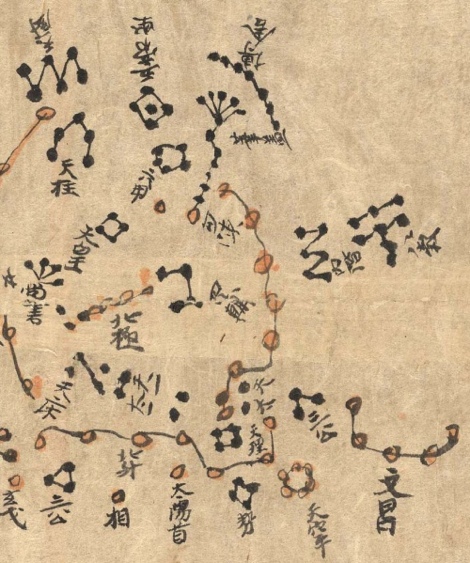
dunhuang_starmap.jpg

Here’s a piece of thin paper 1300 years old: part of the earliest known complete star map, the Dunhuang Star Atlas. It was drawn in China about 650 AD. The paper survived being stored in a cave for an unknown period, and was found in 1907. Image source. More on this and another early Chinese star atlas here.

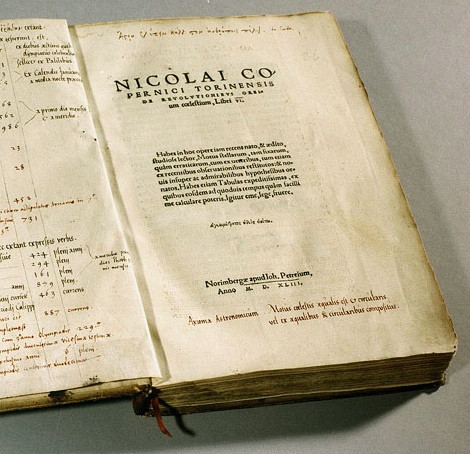
CopernicusPrintedBook.jpg

This book, printed in 1543, is a first edition of On the Revolutions of the Heavenly Spheres by Nicolaus Copernicus. No data loss in nearly 500 years! Copernicus wrote it in Latin, which was then the international language of science, and is now called a “dead” language because it has no living native speakers. But due to its historical and religious importance, there are far more people alive today who can read Latin than can read 16th century Polish, the language Copernicus grew up speaking.