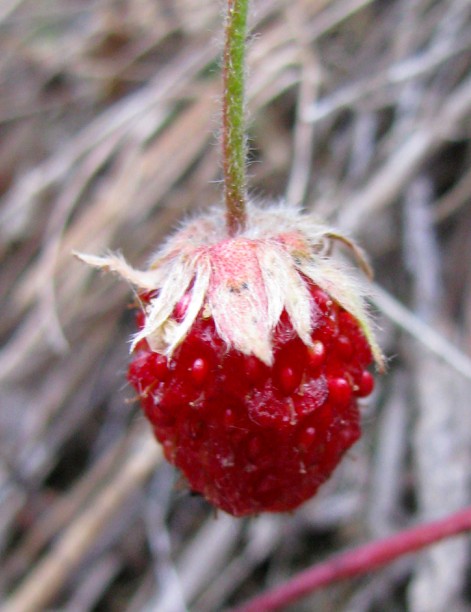
Wild strawberries

It’s been a cool wet spring here in the Siskiyous, but on June 9 we found wild strawberries with dead-ripe fruit.

WildStrawberryRipe.jpg

Irresistible! The fruits were tiny, maybe half an inch in diameter, and didn’t want to separate from the leaves so we each ate one leaves and all. Very juicy and red, sweet, but the intense strawberry flavor I expected to find wasn’t really there. Maybe it’s been enhanced by horticultural selection? Or I got one that wasn’t too tasty? I don’t think a store-sized berry could be so ripe as these were, without being a shapeless blob.

WildStrawberries GreenLeaf.jpg

As to species, this plant could be either the woodland strawberry (Fragia vesca) or the Virginia strawberry (F. virginiana). Both are found all across North America, and are hard to tell apart. In common parlance, the name “wild strawberry” is applied rather indiscriminately to these two species. A third bearing strawberry in North America is F. chiloensis, the beach strawberry, Chilean strawberry, or coastal strawberry, native to the Pacific Ocean coasts of North and South America, and also Hawaiʻi. Migratory birds are thought to have dispersed F. chiloensis from the Pacific coast of North America to the mountains of Hawaiʻi, Chile, and Argentina.

A hybrid of F. chiloensis (for size) and F. virginiana (for flavor) was first made in 1840 in France and this lineage replaced F. frascaand Musky strawberries (F. moschata) as the commonly cultivated strawberry. But people harvested them long before they cultivated them, and one source says that it was “probably during this time that they acquired the name strawberries from the practice of threading them on straws whilst harvesting them,

Strawberries on a straw.jpg

Photo source.

or possibly from the term ‘streabariye’ used by the Benedictine monk Aelfric in AD995 to describe the st[r]aying habit of the runners. Certainly the name strawberry was used long before the practice of placing straw around the fruiting plants became widespread.”

WildStrawberriesRedLeaf.jpg

FDR speaks to us from 1936, and it still applies

President Franklin Delano Roosevelt reflects on the “enemies of peace” with which he struggled in his first term:

“We had to struggle with the old enemies of peace—business and financial monopoly, speculation, reckless banking, class antagonism, sectionalism, war profiteering.


”They had begun to consider the Government of the United States as a mere appendage to their own affairs. We know now that Government by organized money is just as dangerous as Government by organized mob.”

Speech at Madison Square Garden (October 31, 1936)

Franklin_Delano_Roosevelt,1941.jpg

Roosevelt in 1941, signing the Lend Lease Act. Photo source.

At the Food Pantry: Boy and books

There was a gangly boy, perhaps 14 years old, looking through the “Free Books for Kids” at the Food Pantry as I walked over. “Hi, finding anything you like?” I asked. “Well…” he said, ”do you have any comic books? like Spiderman vs. …” “No, the place where I get most of the books doesn’t have any comics, I’m sorry.” He picked up a thick hardback. “This is Harry Potter in Spanish?” “Yes, pretty good way to learn a language once you have some basics.” He made a polite noise and put the book back, but kept looking, telling me that he was moving to North Dakota this summer. That could be real soon, I thought, since tomorrow was the last day of school. “Whoa, that’s going to be a big change from Oregon. Have you ever been there?” “Oh, yeah, a bunch of times, we kinda go back and forth.”

He was a serious young man, with a good smile and a clear gaze. The other two people who’d gotten out of the small car were an older youth, brother I figured—same reddish-blond hair and very fair skin, and a woman who was being “head of household” over at the Food Pantry dock. She looked old enough to be their mom, barely, but then lately everyone seems too young to me.

I rummaged among the books for teens, looking for something he might like. I got few bookseekers his age, mostly my customers were under twelve. At a certain age reading tastes become more individualized, much harder to satisfy from my small stock of secondhand books and library discards. Here, among the chapter books, a fat paperback with a boy hero and “wizard” in the title. And an S.E. Hinton book, Tex, about a boy on his own on a ranch with his siblings after his mother dies and his father leaves to find work. I remembered a line, “I just went on spreading mustard on the baloney and eating it. We were out of bread.” On the cover were a motorcycle, which featured largely in the story, and a rawboned young man wearing a sheepskin jacket and a battered cowboy hat. I put it on the table near him, and looked for more. The (fictional) journal of a boy in the Union Army. One or two more.

The boy bound for North Dakota was still working through the books behind me, arranged in the open back of the car. “What’s this?” he asked, holding out an old grey hardback, a book club edition of Collected Stories of Mowgli. I’d just added it today. “It’s about a boy who’s raised by wolves,” I said, watching his face for signs of recognition. Nothing. “In India,” I added, “and he goes on living in the jungle with the animals. The stories are about his adventures and what he learns from them.” One of my favorite books as a child, I thought to myself, I really should be able to say something more about it. But he was interested. “How much is it?” he asked diffidently. “Oh, it’s free, they’re all free.” His face lightened, and his hand took a firmer hold upon the book. He looked at a few others without choosing any, then turned to the table. The book with “wizard” in the title made the cut, and another. “I’m getting some books for friends,” he said. “Good, that’s good.”

After a bit I ventured to say that he had a long drive ahead of him. “Yeah, three days,” with an air of remembering just how long those days were. “I have some other books to read too, though. Ice Fire and Dark Fire, it’s a series. There’s these two people, they live in a house with a bunch of dragons made out of clay. And a boy comes to live with them, they’re not his family, but he comes to live with them and the clay dragons start speaking to him, they’re not just clay…” Inner voices, not yet silenced, I thought, nodding as he spoke. His head turned quickly, he’d heard his name called though I hadn’t heard. “I’ve got to go now, thanks.” A lot of my interchanges with kids ended this way. “Sure, you’re welcome.”

He made several trips back to the small car with boxes of food, half-gallons of milk, and his brother groaned in a comic fashion under the weight of a large bag of dog kibble. Oh good, they’ve got a dog, hope the dog gets to go, but I won’t ask. Finally they were done, all three coming smiling back to the car; the mother gave me a friendly look, the grey-haired woman with the second-hand books who’d been talking to her son. He veered my way and said, with his open face, “Thanks for the books.” “You’re welcome, I hope you all have a good journey. And good luck in North Dakota.” They smiled and waved and off they went.

A web furnished for concealment, Cyclosa conica

Yesterday’s forest walk, along an alarmingly narrow dirt road next to a hundred-foot drop, introduced us to Cyclosa conica

Cyclosa conica 0781.jpg

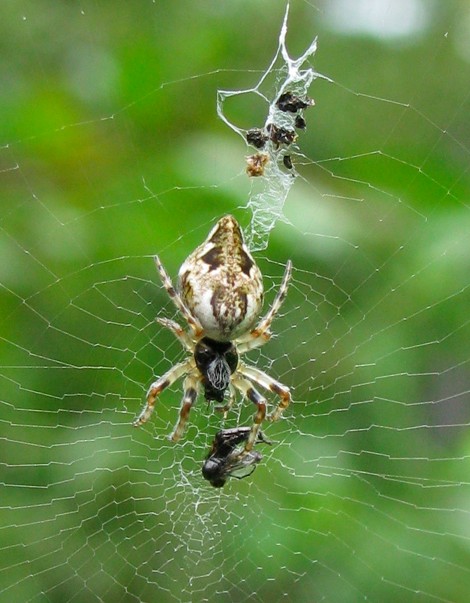
a spider with an unusual tactic for concealment. On its web it makes a vertical strip of reinforced filaments, called a stabilimentum, to which it adds the husks of its prey. Females often place their egg sacs in the stabilimentum too. Then the spider hides itself at the center of this little visual interference area it has made, while it waits for insects to fly into the web.

The vertical strip of insect remains is clear in the photo above, and here’s a closer look at the arachnid itself.
cyclosa conica CR 0781.jpg

The stabilimentum is used in various forms by other orb-weaver spiders (family Araneidae, the builders of spiral wheel-shaped webs).
zig-zag2.jpg

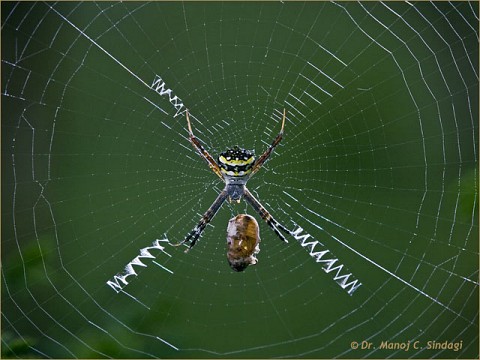
Above, the “Writing or Signature Spider”, Argiope sp., photo taken in Singapore. Source.

Zig-zag3.jpg

Above, stabilimenta of Argiope sp. take different shapes including circular and cross-shaped. Photo from Wikipedia.

What are the functions of the stabilimentum?

Various theories have been propounded as to the effect of the stabilimentum: strengthening the web, preserving the web by causing birds to avoid it, even attracting insects (although it would be natural to think that the more solid-looking stabilimentum might make the webs easier for insects to avoid). The spider we saw makes it into a “decorated” hiding place, but that is most likely an embellishment by this one species upon a structure originally serving other purposes.

In 1998 I-Min Tso, now a professor at Tunghai University in Taiwan, did a field study with Cyclosa conica (the spider we photographed) to find out whether “Stabilimentum-Decorated Webs Spun by Cyclosa Conica (Araneae, Araneidae) Trapped more Insects than Undecorated Webs”. He was able to make the comparison because where he worked (near Pellston, MI), the spiders sometimes omitted the stabilimentum (and 18 out of 24 webs with stabilimenta had no prey included in the “decoration”). This seems odd, as the stabilimentum with prey is cited as a characteristic of the genus Cyclosa, but maybe other observers have failed to notice instances of C. conica webs that lack the stabilimenta, or lack the wrapped prey within them. At any rate, Dr. Tso found that webs with stabilimenta caught more prey than plain webs even when the plain ones were larger. Similar results have been found for other species that add stabilimenta to their webs.

How might this work? At least one species, Argiope argentata (one of the Argiope spp. known as the “Writing Spider”), is said to spin special UV-reflecting silk for the stabilimentum. Theoretically this makes it more visible to insects, like the UV patterns on flowers, which tend to be “bull’s-eyes” surrounding the center where pollination takes place. In a laboratory where the light could be manipulated to contain UV radiation or not, fewer fruit flies flew to webs when the UV light was not present (webs were those of juvenile Argiope versicolor).

UVFlowers.jpg

Seen in UV, these flowers have a wide black “target”. Photo by Tom Blegalski/TTBphoto, from geneticarchaeology.com.

Under that theory, insects would fly toward the attractive UV center of the web (the stabilimentum) and not see the less-visible “this is a spider web!” part until too late. The theory fits the Writing spider, which prefers open sunny areas, better than our C. conica, which lives in sun-and-shade forests.

But the theory may be too good to be true, given that we don’t actually know enough about insect vision and behavior, and there is even disagreement regarding how UV-reflective spider silk is. In the real world, light conditions vary from place to place and moment to moment, even as a breeze changes the orientation of a web slightly, making it difficult to assign easy labels like more visible/less visible. And the visual systems of insects vary, with many being (I venture to say) unknown. The Australian spider Argiope aetherea was found to adjust “the quantity of silk decoration… adding more silk decoration when the web was located in dim light rather than bright light.” The authors of this study cite their findings as evidence that is “[c}onsistent with the prey-attracting function”, but of course it would also be consistent with any other function that involved visual perception even without UV involvement, e.g. signaling birds to avoid the web.

As a non-scientist, I’ve probably taken this topic far enough; the visibility and function of web decorations have been argued over for a hundred years, and modern technology seems merely to guarantee that each investigator with a spectrophotometer reaches a different conclusion from the others. One article (1), in 2005, summarizes areas of difference and ambiguity, ending with a possible redirection of emphasis: “The contrast of web decorations is consistent between families and different decoration patterns, raising the exciting possibility that their shape rather than spectral properties might explain variation in receiver response.” But there’s a review of the evidence in a long article not available online (2, abstract only), and now that my curiosity is up, I’m seeking a reprint of it.

1. Bruce, Matthew J, and Astrid M Heiling and Marie E Herberstein. 2005. Spider signals: are web decorations visible to birds and bees? Biology Letters 22 September 2005. 1 (3): 299-302.

2. Herberstein, M. E. , C. L. Craig, J. A. Coddington and M. A. Elgar. 2000. The functional significance of silk decorations of orb-web spiders: a critical review of the empirical evidence. Biological Reviews of the Cambridge Philosophical Society. 75 : 649-669. [abstract]

More photos and information about Cyclosa conica

eurospiders – good photos including extreme closeups of body parts

Range map

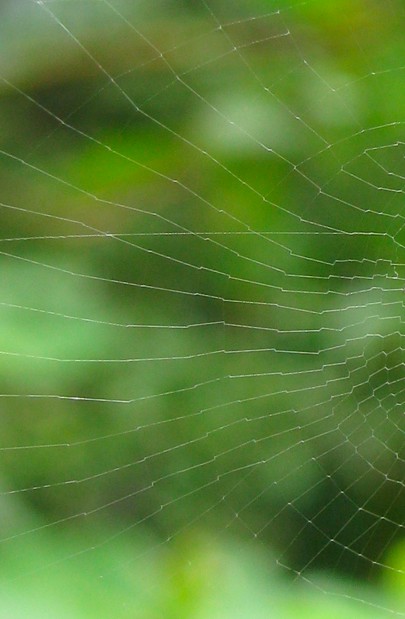
Cyclosa is derived from the Greek “kyclos” meaning “round” possibly with reference to its orb-web. Conica refers to the conical shape of the abdomen.

Cyclosa conica web 0781.jpg